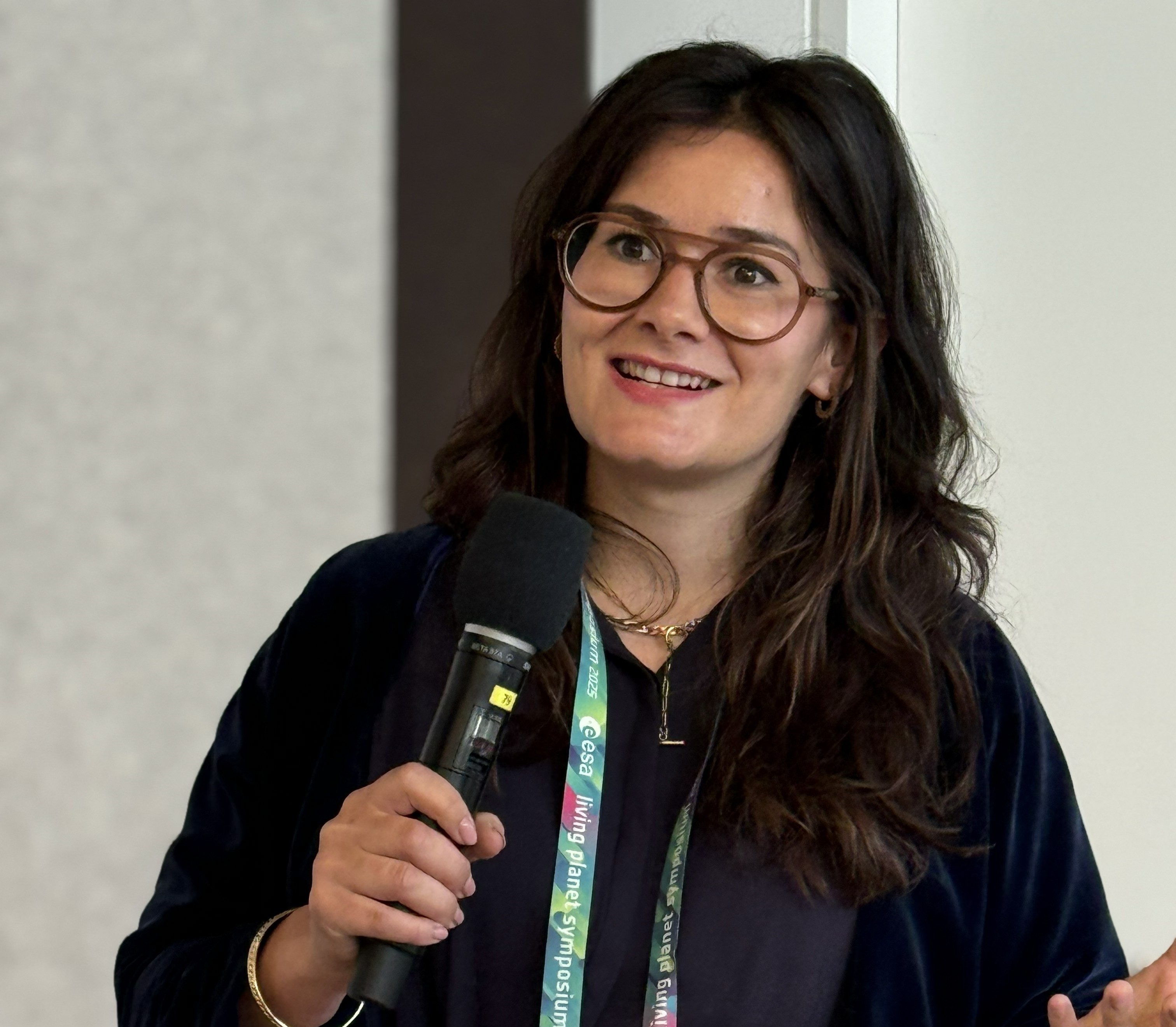
Eliza Maria Link
Session Speaker
Eliza-Maria Link is part of the Vienna Geospace Hub at UIV Urban Innovation Vienna, where she focuses on making Earth Observation data accessible and relevant for real-world urban challenges. Acting as an ambassador for space-based technologies, she connects research, industry and public administration through knowledge transfer, workshops and the development of practical use cases for sustainable cities.
She holds a Master's degree in Geography, specialising in Global Studies and Sustainability, from the University of Vienna, a Bachelor's degree in Environmental and Sustainability Sciences from Leuphana University Lüneburg, and a qualification in journalism. Her previous experience includes working with the European Space Agency (ESA) in Italy on Earth Observation data visualisation and image processing, as well as conducting research on urban air quality at the Helmholtz Centre Hereon. Her work bridges science, communication and innovation, with a focus on turning complex satellite data into practical solutions that support climate-resilient and future-ready cities.
From Space Data to Smart Cities: Turning Digital Twins and Earth Observation into Urban Action
Smart cities are not defined by the amount of data they collect, but by how effectively they turn data into better decisions. While advances in artificial intelligence, geospatial analytics and digital twins are creating new opportunities for urban innovation, a critical challenge remains: how do we bring these technologies into everyday planning and operational workflows?
The Vienna Geospace Hub, an innovation lab operated by UIV Urban Innovation Vienna GmbH was commissioned by the City of Vienna and funded by the Austrian Research Promotion Agency (FFG) and the Federal Ministry of Innovation (BMIMI) addresses this challenge by connecting technology providers, researchers, public authorities and urban stakeholders to translate Earth Observation and geospatial intelligence into practical applications. Rather than focusing on developing individual technologies, the presentation highlights the innovation process behind their adoption: identifying real user needs, combining satellite data with local information, evaluating use cases and building partnerships that can move solutions from research into operational practice. All this with the mission to strengthen the earth observation market and foster user uptake for innovative start-ups and initiatives. Using Vienna as a real-world example, the session demonstrates how space-based data, intelligent analytics and digital urban infrastructure can support more resilient, climate-neutral and future-ready cities.