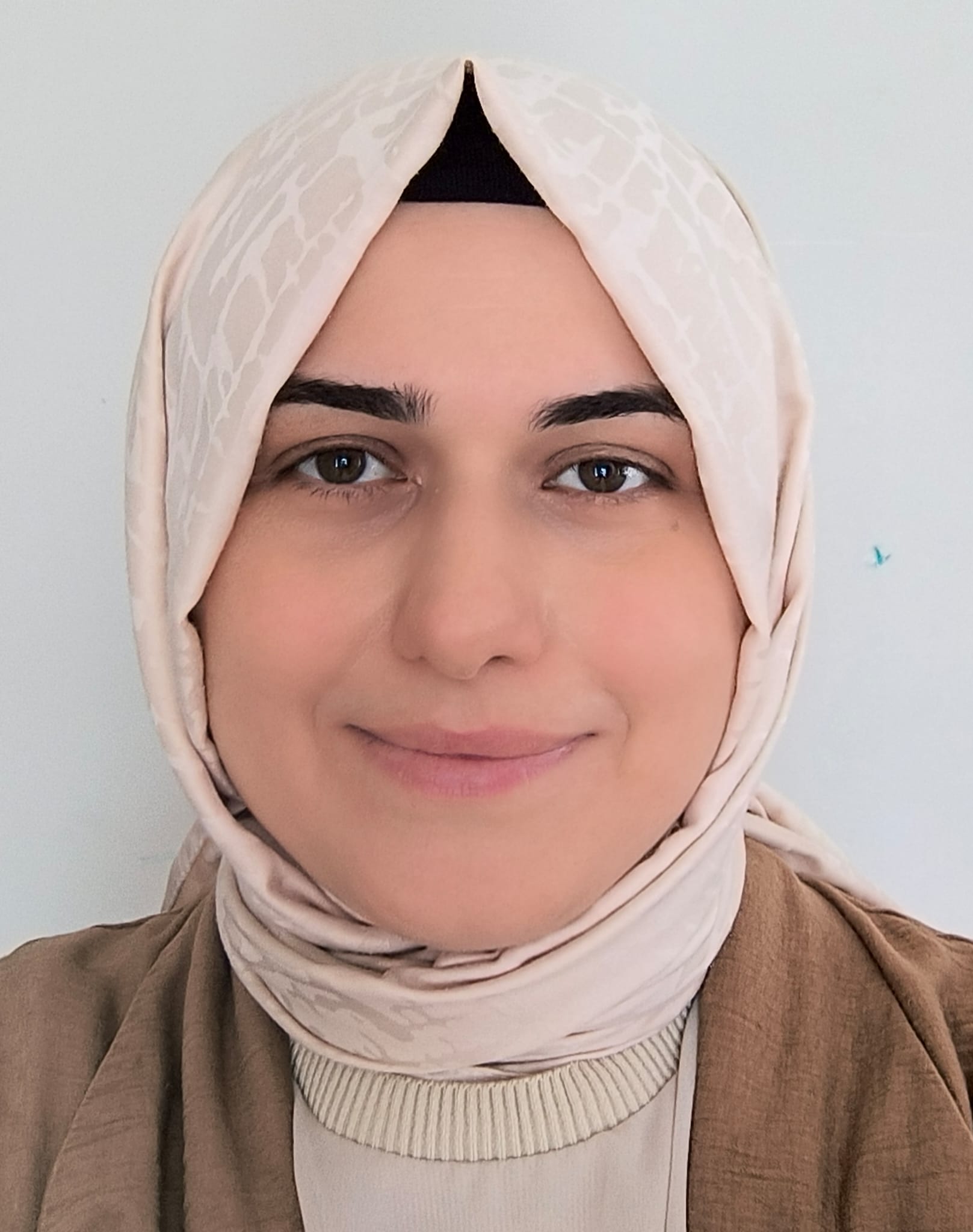
Dr. Ayse Guven Sarihan
Session Speaker
Dr. Ayşe Güven Sarıhan is an Assistant Professor of Mathematics at Ordu University, specializing in pure and applied mathematics with a focus on operator theory, spectral perturbation theory, numerical linear algebra and Hankel and Toeplitz operators. She earned her Ph.D. in Mathematics from Queen Mary University of London and holds an MSc from King's College London. With a strong research profile published in respected international journals such as Linear Algebra and its Applications and Hacettepe Journal of Mathematics and Statistics, she actively leads and participates in competitive research initiatives, including serving as the principal investigator for a TÜBİTAK 3501 Career Development project involving international collaborations. Alongside her research contributions, she has extensive higher education teaching experience across core undergraduate courses including Calculus, Real Analysis, Complex Variables, and Functional Analysis.
Stability of Approximate Canonical Orthogonal Polar Factors under Matrix Perturbations: A Mathematical Framework for Data Mining and Machine Learning
Abstract: Modern data mining and machine learning methods frequently rely on matrix-based computations for data representation, dimensionality reduction, feature extraction, and low-rank approximation. In real-world applications, however, data matrices are often affected by measurement noise, missing observations, data compression, and numerical errors. Understanding how such perturbations influence matrix-based computational procedures is therefore essential for assessing the reliability and stability of data analysis methods.
This study investigates perturbation bounds for the approximate canonical orthogonal polar factor of complex matrices. The mathematical framework is based on additive perturbation analysis and singular value decomposition techniques, with particular attention to matrices whose ranks may differ. Under appropriate assumptions, upper bounds are established for the change in the approximate canonical orthogonal polar factor. The theoretical results are further examined through numerical examples implemented in MATLAB R2025b, allowing comparisons between the derived bounds and alternative estimates.
The relevance of these results to data mining arises from the role of orthogonal transformations, low-rank representations, and subspace-based computations in processing high-dimensional datasets. In particular, the derived perturbation bounds may provide mathematical tools for investigating the sensitivity of dimensionality reduction and feature extraction procedures to noisy or modified input data. Potential areas of relevance include medical image analysis, image recognition, and sensor-based data processing, where data quality and numerical stability are important considerations.
Rather than presenting a specific data mining algorithm, this work establishes a theoretical basis for future investigations into the stability of matrix-based data analysis and learning procedures under perturbations.
Acknowledgements: This work is supported by the TÜBİTAK 3501 Career Development Program under Project No. 124F434.
Keywords: Matrix Perturbation; Polar Decomposition; Approximate Canonical Orthogonal Polar Factor; Data Mining; Machine Learning.