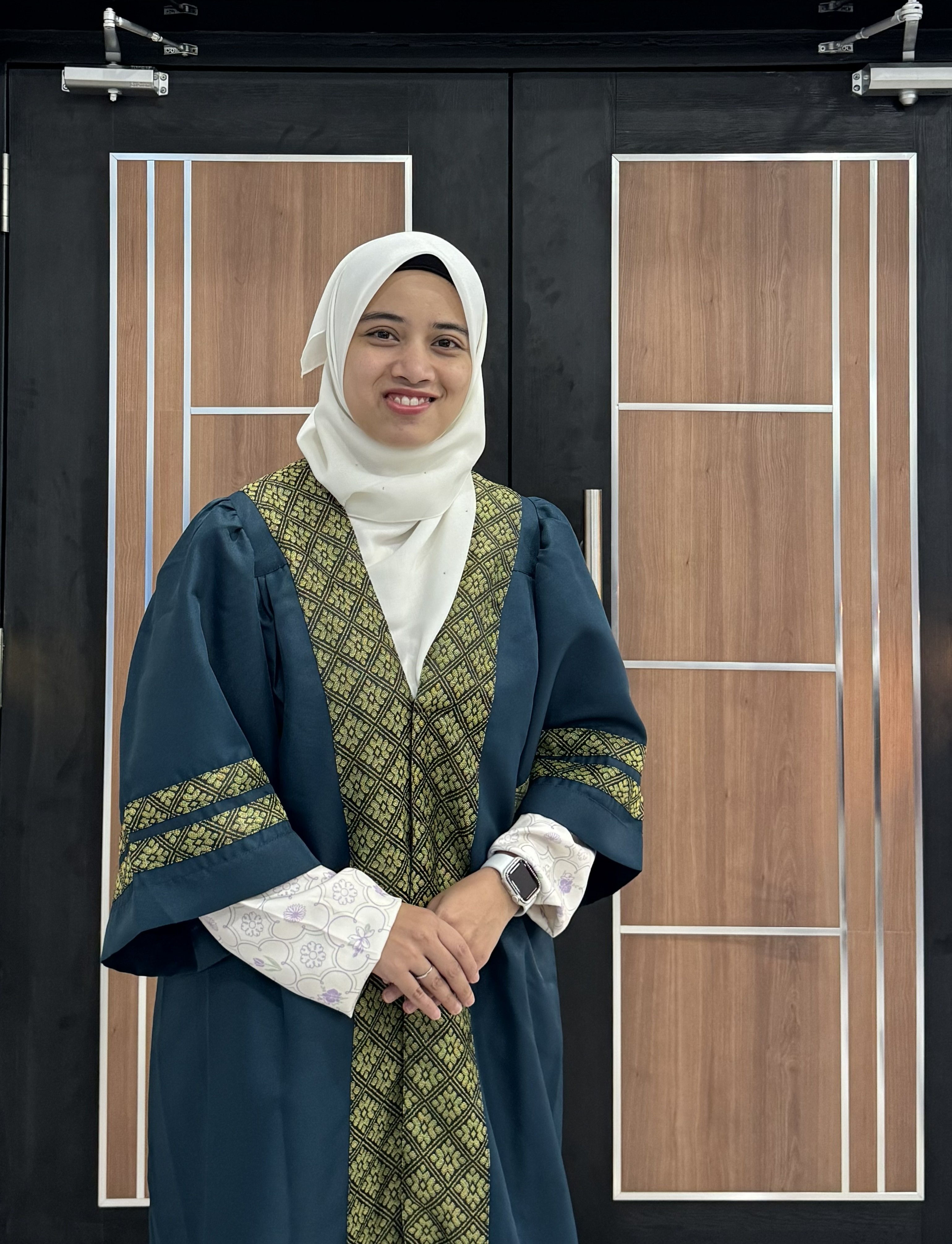
Rasyidah Rehir
Plenary Speaker
Dr. Rasyidah Rehir (M.D., M.Sc.) is a medical doctor and academic specializing in human anatomy, with a strong focus on cadaveric vascular anatomy, neuroanatomical variation, and clinical epidemiology. She currently serves as a Medical Lecturer in the Department of Anatomy, Faculty of Medicine at Universiti Kebangsaan Malaysia, and as a Guest Researcher at the Department of Macroscopic and Clinical Anatomy, Medical University of Graz. Dr. Rehir earned her Master of Science in Human Anatomy from The University of Edinburgh in 2024, following her Doctor of Medicine degree from UKM in 2017. Her academic and research portfolio includes contributions to peer-reviewed journals and authorship of scholarly books, particularly in the field of vascular anatomy and its surgical applications. She has been recognized for her academic excellence and research potential through prestigious awards, including the Merdeka Award Grant for International Attachment. In addition to her academic roles, she has held various positions in clinical practice and healthcare management, demonstrating expertise in quality assurance, audit, and healthcare delivery. Dr. Rehir is an active member of professional bodies such as the Anatomical Society (UK), the Malaysian Anatomical Association, and the Malaysian Medical Council, reflecting her ongoing commitment to advancing anatomical sciences and medical education at both national and international levels.
Cadaveric vascular anatomy, neuroanatomical variation, and clinical epidemiology. The Evolving Landscape of Soft Embalming in Asia (2021–2025): A Systematic Review and Bibliometric Analysis of Various Techniques and Research Applications. Background: Soft embalming is increasingly recognised as an alternative to conventional formalin-based cadaver preservation because it better preserves tissue flexibility, colour, texture, and handling characteristics important for anatomy education, procedural simulation, and surgical skills training. In Asia, techniques such as Thiel embalming, saturated salt solution, and Genelyn have attracted growing interest, but their regional distribution, technical variation, and applications have not been comprehensively synthesised. This study reviewed soft-embalming research in Asia from 2021 to 2025, focusing on preservation techniques and their roles in medical education, professional training, and research. Methods: This systematic review and bibliometric analysis were conducted in accordance with the PRISMA 2020 guidelines. Searches of PubMed and Web of Science identified 452 records (PubMed, n = 229; Web of Science, n = 223). After removal of 188 duplicates, 264 records underwent title and abstract screening, with 76 excluded. Of 188 reports sought for retrieval, 4 were not retrieved, leaving 184 full-text reports assessed for eligibility. Of these, 110 were excluded for not being related to soft embalming and/or the review objective (n = 40) or for being conducted outside Asia (n = 70). Citation screening identified 6 additional studies, resulting in 80 studies included in the final synthesis. Results: Eighty studies published between January 2021 and November 2025 were included. Publication output increased from 11 studies in 2021 to 22 in 2025. Japan was the leading contributor, followed by Thailand and India, while East Asia was the largest contributing subregion. Thiel and modified Thiel embalming were the predominant methods. Simulation-based applications were most common, followed by anatomical and biomechanical or kinematic studies. Conclusions: Soft. embalming research in Asia is expanding, particularly in simulation-oriented and educational applications, with Thiel-based methods predominating. However, the evidence remains geographically concentrated and methodologically heterogeneous, highlighting the need for greater standardisation, broader regional participation, and further comparative research. Keywords: Thiel’s method, saturated salt solution, Genelyn, embalming, cadaver preservation, education, simulation, surgical training.