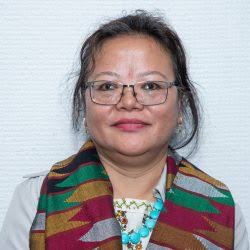
Shyamu Thapa Magar
Invited Speaker
Shyamu Thapa Magar( Ph.D.), Associate Professor, working at Central Department of Anthropology, and Chancellor,Nepal Magar Academic Council, Nepal Magar Association. She also runs women cooperative for women to financially strengthen their position through saving little by little making their strong position within their households. Her interest on doing research on indigenous Magars and their strong hold on constructing Magar identity standing Nepal Magar Association brought many articles and research reports. She has published Magars’ identity issues and focused same on her doctoral dissertation. Magars’ issues are the major interests she focused besides conflicts issues, development sectors, gender and feminism. She is currently teaching Research Methodology, Kinship studies and Gender and feminism for Masters and MPhil courses
Impact of Hydro-power Development on Indigenous peoples of Nepal: A case study of indigenous Magars affected by Tanahu Hydropower project
Abstract:Hydro-power development in Nepal is an essential source of electricity for people living in Nepal which is not only useful for the Nepali people but also become income source for the country to enhance its economic condition. Mega hydro-power projects developed previously has been not able to reach all the Nepali houses due to increasing of the population and the topographical situation. Utilizing the water resources that has been flowing unused needs more mega project to reach every households. Tanahu Hydropower Limited, established in 2012 as a subsidiary company of Nepal Electricity Authority to develop the 140 Megawatts Tanahu Hydropower Project co-funded by the Asian Development Bank, the Japan International Cooperation Agency, and the European Investment Bank(EIB). The affected households were provided compensation under the resettlement plan except 31 among 547 households. Highly affected households are still fighting for their rights and position against the resettlement plan especially coming from indigenous Magar community, the largest indigenous group in Nepal. They claimed that the process of resettlement plan was biased, not following the proper process on delivering the information, not following the FPIC and disregarded the indigenous rights for their existence. Government is not giving importance whereas they are still fighting with filing application to ADB and EIB and not getting justice despite of the support ADB initiated to solve the problem due to Nepali government rules and regulation barriers. This research was conducted to find the exact situation of the indigenous people suffering from resettlement was several visits to the community conducted from 2021-2023, through observation, group discussion and interviews.
Key words: Hydro-power, indigenous people, resettlement plan, indigenous rights, FPIC