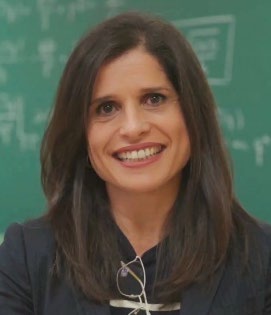
RAQUEL CABALLERO AGUILA
Keynote Speaker
Raquel Caballero-Águila is a Full Professor in the Department of Statistics and Operations Research at the University of Jaén. She earned her MSc and PhD in Mathematical Sciences from the University of Granada and specializes in stochastic systems, sensor networks, signal processing, and distributed estimation. Professor Caballero-Águila has led several nationally funded research projects in Spain and has published more than 89 peer-reviewed international journal articles. Her research has received significant international recognition, with over 1,700 citations and an h-index of 23 on Google Scholar. She has delivered keynote talks at international conferences, supervised doctoral research, and collaborated with leading institutions worldwide, including Harbin University of Science and Technology. Her academic excellence has been recognized through multiple national research awards and evaluation distinctions in Spain
Challenges and advances in distributed estimation for networked stochastic systems Distributed estimation in networked stochastic systems has become a cornerstone of modern signal processing, control, and monitoring applications. Under the assumption of perfect communication links, centralized estimation approaches —in which all sensor measurements are transmitted to a fusion center where a global estimator processes the complete dataset— can achieve optimal performance. However, in real-world networked systems, communication channels are often imperfect, and transmitting all data to a central node can be impractical or even infeasible, especially in large-scale or geographically distributed networks. By enabling individual sensor nodes to estimate global system parameters through localized computations and limited communication with neighboring nodes, distributed strategies overcome these limitations, offering scalable, robust, and energy-efficient alternatives to centralized methods. These advantages are particularly vital in resource-constrained environments such as wireless sensor networks, industrial automation systems, and autonomous multi-agent platforms.This keynote presents a global overview of recent advances in distributed estimation, with an emphasis on addressing key practical challenges encountered in real-world deployments. After introducing the fundamental principles of distributed estimation and its advantages over centralized schemes, we focus on four critical issues: (i) random variations in system parameters, (ii) quantization effects due to limited measurement resolution, (iii) temporal correlations in observation noise, and (iv) the presence of mixed random attacks. Recent theoretical developments addressing these challenges will be presented. The talk concludes with a discussion of promising future directions, including the analysis of communication delays and packet dropouts on estimator performance, the design of distributed estimation mechanisms under complex and dynamic attack scenarios, and the integration of random-access communication protocols as an active defense mechanism against potential attacks. Key references will be provided for researchers interested in further exploring the mathematical foundations and engineering applications of distributed estimation