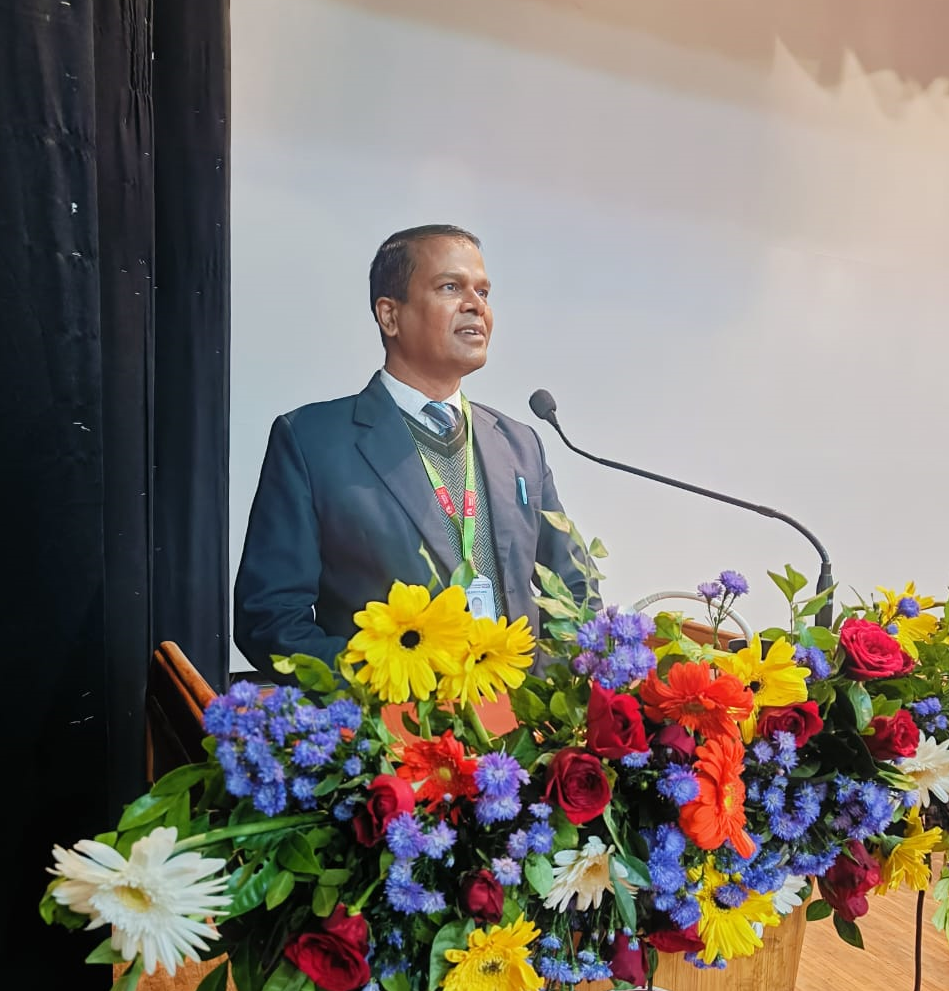
Ranjan Upadhyaya
Session Speaker
Dr. Ranjan Upadhyaya, pursued his doctorate from Vikram University, Ujjain, Madhya Pradesh. He started his corporate path form National Thermal Power Corporation (NTPC), Lucknow, Utter Pradesh. High enriched academic career glittered with Rai University from Bhopal, Madhya Pradesh and continued to Sri Shankarchary College of Engineering and Technology, Bhilai, and Banasthali University, Jaipur, Rajasthan for enriched eight years. Professor at Universal Business School, Mumbai and Director at Jaipur National University before joining, Narsee Monjee Institute of Management Studies, (NMIMS) Mumbai, Maharashtra and Dean –Academic from St Xavier’s, Bangulur, Karnataka. He has many national and international publications of higher reputed and has attended a large number of national and international conferences and workshops. He is a member of professional bodies and supervised several scholars for higher studies India and aboard. Besides this, his contribution was majorly in chairing academic sessions in IIT’s and IIM’s. His true worthiness excellence came out in form of publications, critical reviews, accepted in Harvard Business Review and many more internationally reputed journals like McGraw-Hill. The corporate - academia interface excellence has been endorsed with his contribution in number of completed and ongoing projects. The tie – ups and collaborative work as director with abroad universities like Cardiff Metropolitan University, U.K. and Collagen University, Germany, are hallmark of his excellence in his brief nineteen years of professional career. He still is being associated with UGC and AICTE panels in various platforms like AICTE- UHV and in Smart India Hackathon 2023 organizing committee etc. Re-invited in IIT-Mumbai in e-CELL member for Asia biggest extravagances. In his capacity, he has been chairing various IEEE conferences for different session in O.P. Jindal University. Uzbekistan based Sharda University , on behalf of Microsoft Corporation One Microsoft Way, Redmond, WA 98052 for research paper reviewer for the IEEE International Conference on Computational Intelligence Systems and Devices (ICCISD-2026), Scheduled to be held on July 23–24, 2026 in Greater Noida, India and many more in his basket. His showcase is close association with clean and sustainable energy and all seventeen Sustainable Development Goals (SDGs).
Somnolent turn up of Carbon Capture, Storage & Utilization (Abstract):CCUS encompasses the collection of CO2, typically from major point sources such as power plants or industrial sites that utilize fossil fuels or biomass for energy. When not utilized on-site, the collected CO2 is compressed and moved via pipeline, ship, rail, or truck for various applications or injected into deep geological sites like depleted oil and gas reservoirs or saline aquifers. CCUS can be added to current power and industrial facilities, enabling them to keep functioning. It can address emissions in challenging sectors, especially heavy industries such as cement, steel, or chemicals. CCUS facilitates the production of low-cost low-carbon hydrogen, aiding in the decarburization of various sectors within the energy system, including industry, trucks, and ships. Ultimately, CCUS has the capability to extract CO2 from the atmosphere to offset emissions that are inevitable or challenging to mitigate. CCUS implementation has lagged behind forecasts in the past, but recently there has been significant progress, with more than 700 projects at different stages of development throughout the CCUS value chain. Nonetheless, even at that level, the implementation of CCUS would still fall significantly short of what is needed in the Net Zero Scenarios. Approximately 45 commercial facilities are currently functioning that implement carbon capture, utilization, and storage (CCUS) in industrial applications, fuel transformation, and energy generation. CCUS implementation has lagged behind predictions previously, yet momentum has significantly increased in recent times, with more than 700 initiatives at different phases of development throughout the CCUS value chain. In 2023, the reported capture capacity for 2030 grew by 35%, and the reported storage capacity increased by 70%. This result in the total CO2 that might be captured by 2030 being approximately 435 million tons (Mt) annually, with the declared storage capacity reaching about 615 Mt of CO2 each year. While this instigation from adverts is positive, it still just around 40(and 60, independently) of the circa 1 Gt CO2 per time which is captured and stored in the Net Zero Emigrations by 2050(NZE) script. Government backing for CCUS continued in 2023 as ongoing subvention programmes in the United States and Europe made over USD 20 billion available to CCUS systems. This includes the USD 1.7 billion that was made available to carbon prisoner demonstration systems and the USD 1.2 billion for DAC capitals promised under the 2021 structure Investment and Jobs Act in the United States. In the Netherlands, the SDE scheme allocated over USD 7.3 billion to CCS systems that will connect to the massive Aramis CO2 transport and storehouse network. In Demark, Ørsted entered USD 1.2 billion from the CCUS Fund for its prisoner build design on the Asnæs Power Station. On top of individual country- position backing, the European Commission also issued around USD 1.5 billion to CCUS systems in the assiduity sector under the rearmost Innovation Fund round, and over USD 500 million to CO2 transport and storehouse systems under its Connecting Europe Facility programme. With respect to India's 2026 focus for Carbon Capture, Storage & Application (CCUS) involves launching R&D Roadmaps, establishing National Centres of Excellence( like at IIT Bombay), & exploring littoral CCUS( seaweed, ocean alkalinity) to decarbonizes heavy diligence( cement, sword) and meet its 2070 Net- Zero thing, using CCUS for precious products( hydrogen, chemicals) and storehouse in geology/ abysses, with transnational collaboration pivotal for tech gaps. In substance, India sees CCUS as a core pillar, integrating R&D, airman systems, and blue carbon enterprise to ground the gap to its 2070 Net- Zero thing, transubstantiating a waste product( CO2) into a resource.