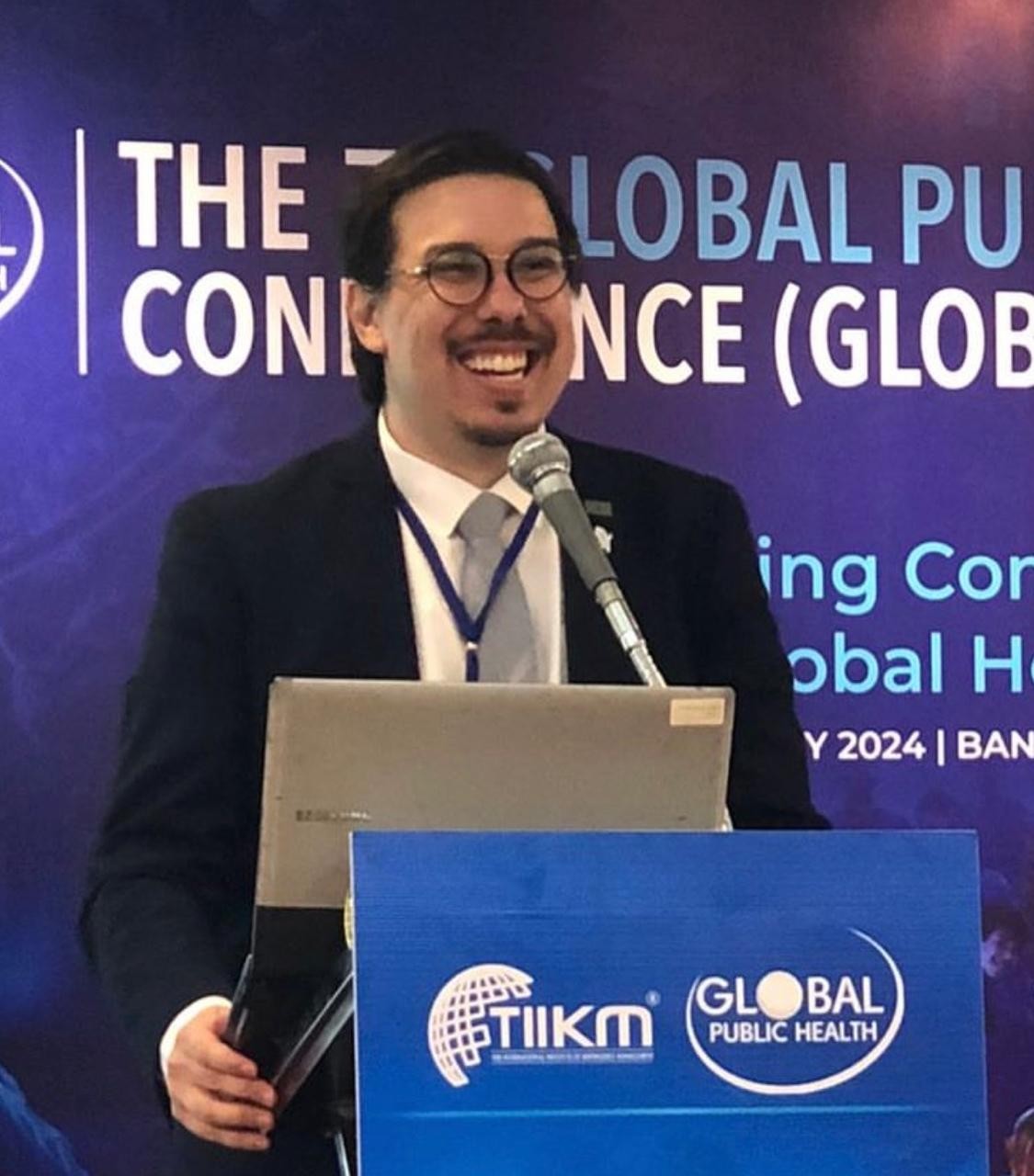
Mario Angelo Cenedesi Júnior
Session Speaker
Prof. Dr. Mario Angelo Cenedesi Júnior, MD, PhDAssociate Professor in the PhD in Public Health program at the Universidad de Ciencias Empresariales y Sociales (UCES), Argentina. He is currently a visiting scholar at the Institute of Sociology at Academia Sinica in Taipei, Taiwan, and a research fellow supported by the Ministry of Foreign Affairs (MOFA) of Taiwan Medical degree from the Faculty of Medicine at the Centro Universitário Barão de Mauá, Brazil; PhD in Public Health with a specialization in Epidemiology from the Universidad de Ciencias Empresariales y Sociales (UCES), Argentina; MBA in Health Management from the University of São Paulo (USP), Brazil; postgraduate specializations in Public Health, Mental Health and Psychosocial Care, History of Religions, History of Art, Palliative Care and Pain Therapy, Social Sciences, and Anthropology Scholarship holder of the Brazilian National Council for Scientific and Technological Development (CNPq) through the Brazilian “Science Without Borders” program, having completed part of his undergraduate medical training as a visiting student at the Faculty of Medicine and Health Sciences at the University of Alcalá, Spain, and carrying out hospital training at the Ramón y Cajal University Hospital in Madrid.Postdoctoral fellowship at the Human Rights Observatory in Portuguese-Speaking Countries, Portugal; non-funded postdoctoral researcher at the Centre for Research in Anthropology and Health, Faculty of Science and Technology, University of Coimbra, Portugal; non-funded postdoctoral researcher at the Lusíada Centre for Research in Social Work and Social Intervention, Lusíada University, PortugalExperience in Epidemiology, Vaccine Hesitancy, Sexual Education, Mental Health, Research Methodology, Public Health Policies, Anthropology and Sociology of Health, Latin American and Asian Health Systems, and Public Health in different contexts
Contemporary Challenges of Brazilian Public Health: State, Society, and Care Policies Introduction: Vaccine hesitancy has become an increasingly significant public health concern, shaped by a range of psychosocial, cultural, and anthropological determinants. Identifying these factors is crucial for informing communication strategies and vaccination policies. This descriptive-analytical study sought to examine the factors associated with parental hesitancy toward vaccines for children up to 6 years of age in a small municipality in the state of São Paulo, taking into account familial, religious, cultural, and social influences. Methodology: A descriptive-analytical cross-sectional design was employed, involving a sample of 250 participants (95% confidence level, 5% margin of error). Parents or legal guardians of children aged up to 6 years were included. Data collection took place in 2025 through a structured questionnaire covering sociodemographic variables as well as cultural, religious, psychosocial, and behavioral dimensions related to childhood vaccination. Analyses included descriptive statistics and association tests (chi-square), with a significance threshold of p < 0.05. The study was conducted in a small city located in the interior region of São Paulo, Brazil. Results: Of the 250 participants, the majority were mothers (60%) and female respondents (64%). Most identified as White (52%), followed by mixed-race (28%) and Black (20%). Regarding educational attainment, 32% had completed high school. In terms of religion, 28% identified as Catholic, 28% as Evangelical, 4% as agnostic, while 28% either did not respond or did not know. Vaccination status was up to date in 68% of cases, whereas 32% reported delays; 28% expressed vaccine hesitancy. Disagreement with partners regarding vaccination occurred in 16% of cases, predominantly in favor of non-vaccination, while 52% reported never experiencing disagreement. During the COVID-19 pandemic, 64% reported heightened concern regarding vaccines and 64% perceived an increase in misinformation. Statistically significant associations were identified between gender and disagreement with partners about vaccination (χ² = 26.5; p < 0.001), with women more likely to oppose vaccination decisions. The pandemic period was associated with increased concern, particularly among women and mixed-race participants (χ² = 69.2; p < 0.001). Perceived misinformation was also higher among women (χ² = 13.4; p = 0.001) and mixed-race participants (χ² = 143; df = 4; p < 0.001). Catholic participants exhibited higher levels of insecurity (χ² = 36.0; p < 0.001) and vaccine hesitancy (χ² = 31.7; p < 0.001), as well as stronger influence of faith (χ² = 122; p < 0.001) and a greater tendency to follow religious leaders’ guidance (χ² = 161; p < 0.001). Conclusion: The results suggest that public health interventions should extend beyond ensuring vaccine availability, incorporating culturally tailored communication strategies, health education aligned with familial and religious belief systems, and strengthened community engagement to mitigate misinformation. Public policies that are sensitive to the sociocultural profile of the population are essential to enhance vaccine confidence, improve coverage rates, and ensure effective child protection. Keywords: Vaccine hesitancy; Parental attitudes; Childhood immunization; Psychosocial determinants; Anthropological influences