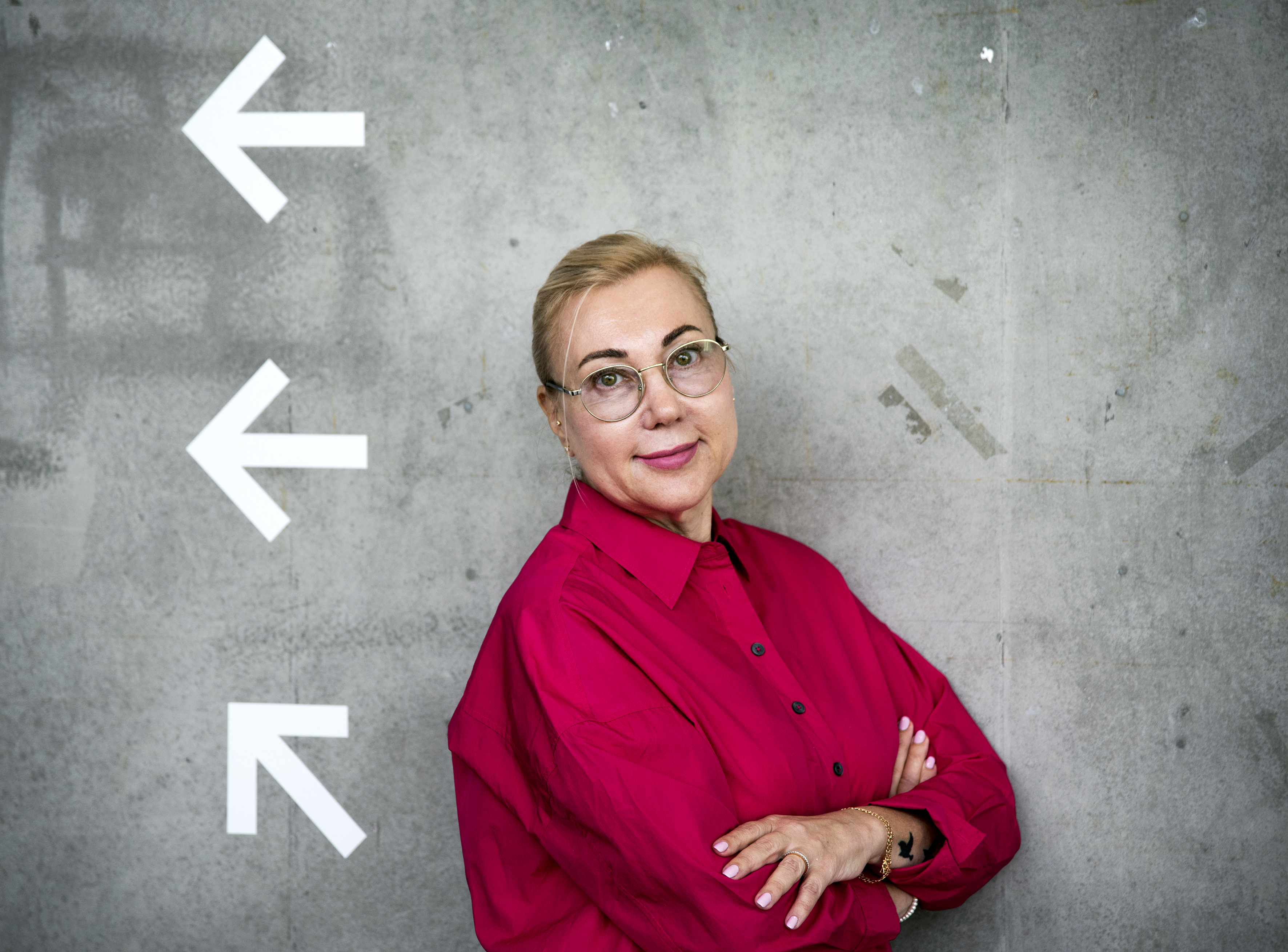
Natalia Karlsson
Session Speaker
Natalia Karlsson is an Associate Professor of Mathematics at Södertörn University, Sweden. Her qualifications include a master’s degree in mathematics, a master’s degree in education, and a PhD in mathematics and physics. Research areas are mathematics education and applied mathematics. Areas of expertise in the field of mathematics education have a focus on developing theoretical and methodological approaches to teaching, crucial mathematical content, and the variation in and the relationships between the teaching and learning of mathematics. The research expertise enhances methodological approach to theoretical outlines about students’ learning and the collaboration between teaching content and learning, including learning diversity, the variation in and relationships between the teaching and learning of mathematics, problem-solving and Vygotsky's’ grounded theory focusing on an interplay between teaching of mathematical content and students’ knowledge development. Areas of research expertise in applied mathematics are in mathematical modeling and a non-linear dynamic theory of elasticity, constructing mathematical models and choosing mathematical methods, both analytical and numerical, for solving non-linear systems of partial differential equations and integral equations. This was also the topic of PhD thesis, which was supervised by Professor and Member of the Russian Academy of Sciences (RAS) Anatoly A. Burenin. Research expertise in applied mathematics also deals with fuzzy methods and their applications to formalizing a strategy map. These methods are used to find functional relationships between the elements of a strategy map and are based on Mamdani's fuzzy inference system. Assoc. Prof. Karlssons’ results of research have been presented in various (co-)-authored scientific publications, book chapters and books for higher education and compulsory school, among other books, about teaching and learning mathematics, problem-solving and problem-solving for advanced (gifted) education. She had served as a visiting professor in South Africa university and collaborates continuously with universities from different part of the world. She leads a research network LIMER.
Rethinking fundamental algebra in terms of learning architecture With the aim of extending the applicability of fundamental theoretical mathematical concepts to educational contexts, the present study examines and analyzes relevant algebraic content that supports learners’ understanding of existing quantified relational premises and scientific learning content and algebraic concepts. The purpose of this analytical study is to investigate how algebraic content-such as the contributions of Van der Waerden (1973), Freudenthal (1973), and Vergnaud (1983; 1994)-should be developed and applied within mathematics education, with a focus on Vygotsky’s (1986; 1998) research-based learning framework. The study also examines theoretically grounded learning content, including multiplicative structures, Abelian semigroups, and inverse operations, which facilitate an optimal transition and interplay between fundamental algebra within a learning architecture and students’ mastery of scientific algebraic concepts. To provide a foundation for this learning architecture, the study presents a theoretical conceptualization of how the learning process should engage, systematize, extend, and conceptually integrate students’ understanding into a new algebraic context.