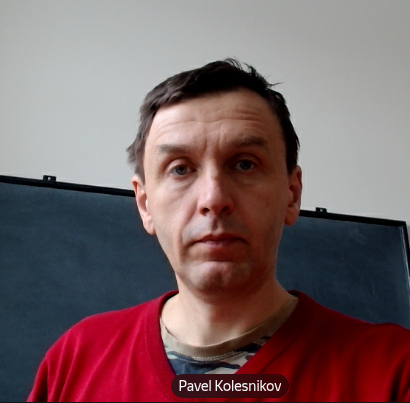
Pavel S Kolesnikov
Session Speaker
Algebra and ring theory, with a focus on conformal algebras, operads, and nonassociative algebraic structures.
Pavel S. Kolesnikov (born December 31, 1977, in Novosibirsk, Russia, former USSR) is a mathematician specializing in algebra and ring theory. He received his Bachelor’s (1998) and Master’s (2000) degrees in mathematics from Novosibirsk State University, followed by a Candidate of Science (Ph.D.) in 2003 and a Doctor of Science (Habilitation) in 2008 from the Sobolev Institute of Mathematics. He has been affiliated with the Sobolev Institute of Mathematics since 2003, progressing from research fellow to leading research fellow, and served as Head of Laboratory from 2010 to 2022. At Novosibirsk State University, he has taught since 2000 and has been a Professor since 2018. His international experience includes a postdoctoral fellowship and visiting appointments at the Korea Institute for Advanced Study, visiting professorships at the University of California, San Diego, and the University of São Paulo. Prof. Kolesnikov’s research focuses on algebra and ring theory, particularly algebraically closed skew fields, conformal algebras, pseudoalgebras, dialgebras, and dendriform algebras. He is the recipient of the Pierre Deligne Contest Prize (2005) and has authored numerous influential publications in leading international journals. Reference: Chiral algebras and the Manin product of operads Poisson algebras emerged as a tool in mechanics and geometry remain to be the objects of interest for algebra. For example, the solution of long-standing Nagata problem (I.P. Shestakov and U.U. Umirbaev, 2004) is based on the study of Poisson brackets. A ``mutation'' of this notion made by S.P. Novikov et al in 1980s for the purpose of inventing Hamiltonian formalism for partial differential equations led to the class of algebras now called Novikov algebras. The latter are actively studied by nonassociative algebra people. In fact, Novikov algebras are ``minor siblings'' of the more extended class of systems called Lie conformal algebras (V.G. Kac, 1996). Conformal algebras originated from the theory of vertex algebras appeared as a tool in mathematical physics (conformal field theory) or representation theory (infinite-dimensional Lie algebras and finite groups). As it was shown by B. Bakalov and V.G. Kac (2002), a vertex algebra may be thought of as a deeply generalized analogue of a Poisson algebra. In our talk, we consider even more extended class of systems (chiral algebras by A. Beilinson and V. Drinfeld, 2004) so that vertex algebras in mathematical physics are chiral Lie algebras. It turns out that the class of chiral associative algebras is somehow degenerate and thus it is of very limited interest. This phenomenon can be explained on a model series of examples: chiral algebras with an abelian conformal part. The structure of such algebras is completely described in combinatorial terms by means of the Manin black product \(\bullet\) of operads (V. Ginzburg and M. Kapranov, 1994). Namely, for an arbitrary binary quadratic operad Var, a chiral Var-algebra with an abelian conformal part is exactly the same as a differential \((Var\bullet Com)\)-algebra. Occasionaly, the case Var=Pois (the operad of Poisson algebras) is of special interest from this point of view since the Manin black product \(Pois\bullet Com\) almost coincides with Com. Hence, the class of chiral Poisson algebras (different from what is known as Poisson vertex algebras) is a perspective object for algebraic study as well as a source of models in mathematical physics.