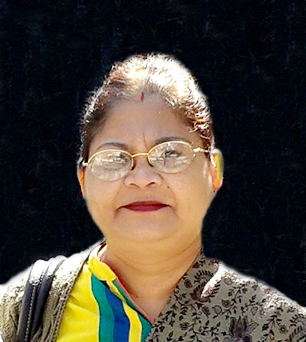
KETAKI DAS
Delegate Speaker
Anthropology of health, development studies, social impact assessments, health system strengthening, and policy design, with a focus on improving healthcare and development outcomes in underserved communities.
Dr. Ketaki Das holds a Ph.D. in Anthropology from the Indian Statistical Institute and Calcutta University (1994), along with an M.Sc. in Anthropology (1985) and a B.Sc. (Hons.) from Calcutta University (1982). She is proficient in English, Bengali, Hindi, and Oriya.
With over 24 years of experience, Dr. Das has led and contributed to various research projects, including need assessments, baseline surveys, impact evaluations, and social impact assessments. She has worked extensively in project planning, management, monitoring, and evaluation, particularly in the development sector and health systems strengthening. Her expertise spans large-scale development initiatives and infrastructure projects, collaborating with national and international organizations and governments.
Dr. Das has held academic roles as a Guest Lecturer in Healthcare and Hospital Management at IISWBM, Calcutta University, and in Anthropology at Calcutta and Vidyasagar Universities. She has published 28 scientific papers in esteemed journals and authored three books.
She has received numerous awards, including the Young Scientist Award by the Indian Society of Human Genetics (1991) and fellowships from the Indian Statistical Institute and the Department of Science and Technology (DST), Government of India. Dr. Das's vast experience and contributions to research and development make her a recognized expert in her field.
Reference:Enabling marginalized voices for reducing healthcare inequalities and improving health outcomes - A Community Driven Approach
Health for all is a global strategy which gave high priority to community participation (WHO 1978). Rural healthcare is one of biggest challenges especially in unserved and underserved rural areas. Marginalization also occurs due to power imbalances, which hinder them from being recognized/heard or considered. Weak voices of people and low accountability are constraints to effective healthcare delivery. Awareness generation and change in behavior on public health issues are achieved through various capacity building activities. A community-driven approach is a global development approach, which emphasizes the active involvement, community participation in decision-making to enhance access, utilization, and outcomes, focusing on local needs and resources in women's healthcare by empowering women through knowledge, skills, and resources, and creating a supportive environment for their health needs.
West Bengal Voluntary Health Association is working closely with marginalized communities in un-served/under-served rural areas that lack sufficient services through Basic Health Care Support Program (BHCSP), which transformed into a community-level health platform over time in five districts of West Bengal and creates a multi-stakeholder dynamic to strengthen Health System and provides insight into the presence/role and raising voices of marginalised in interfaces between the service providers and decision makers, which promotes ownership, joint planning/decision-making, implementation and accountability between local governments and health services; which enables to express their priorities/concerns and negotiate with healthcare-providers for problems resolution, experience and exercise influence on their own lives and assists government in fulfilling commitments by identifying operational/policy gaps and providing services. BHCSP engaged people with power for advocacy perspectives and people without power for empowerment process.
Both qualitative and quantitative methods were used to understand the process. Community Score Cards were used prior to organizing interface meetings, which enhanced good governance by encouraging participation, transparency, social-public accountability, informed decision-making, and fostering more responsive service providers. Interface between service users and providers are given equal weight, which aim to enhance governance by fostering mutual trust, power-sharing, efficacy, responsibility and hastens peoples’ problem-solving, are found to improve healthcare utilization and trigger intermediate improvements for quality of life, better health outcomes and make more responsive to requirements/policy. Intense awareness is necessary to ensure, more people to know the processes for better healthcare.
Community driven approach is a time taking process. Women empowerment can be attained through careful planning, skills enhancement, deliberate decision-making and substantial investments.