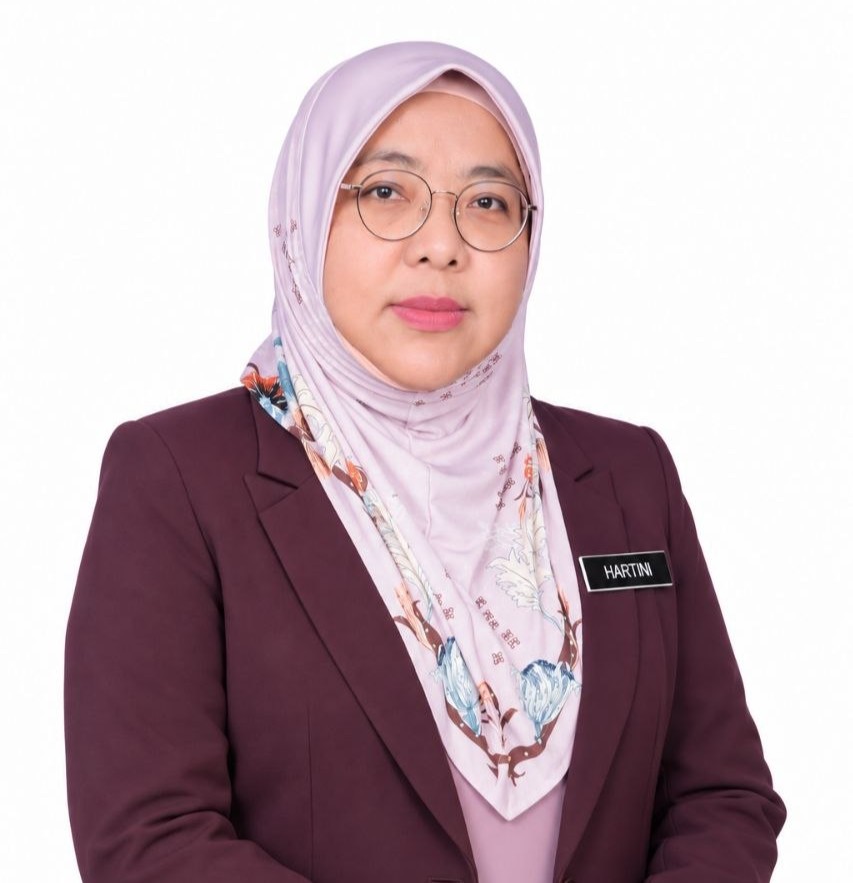
Dr. Hartini Hashim
Invited Speaker
Dr. Hartini Binti Hashim is an experienced Science and Chemistry educator from Malaysia with more than two decades of teaching experience. She currently serves as a Graduate Education Service Officer at SMK Sultan Ismail, Kota Bharu, Kelantan, where she teaches Science and Chemistry. She holds a PhD in Science Education (Teaching & Learning) from Universiti Sains Malaysia, a Master’s in Chemistry Education and a Bachelor’s in Science Education (Chemistry) from Universiti Pendidikan Sultan Idris. Her professional experience includes teaching lower secondary Science and Chemistry, serving as an SPM Paper Examiner, and contributing as a Chief Trainer (JU) in PISTEK. Dr. Hartini has received several prestigious recognitions for her contributions to STEM education, including the Best STEM Teaching Award, Innovative STEM Teacher Award, International Teaching Innovation Aspiration Award, and the Excellent Service Award from the Ministry of Education Malaysia. In 2022, she was appointed as a PETRONAS Foundation Teacher Ambassador. In 2025, she was recognized as a STEM Teacher Icon at the State Level by the Ministry of Education Malaysia. Her professional interests focus on STEM education, innovative teaching and learning, Chemistry education, and the integration of innovative approaches in science teaching.
Pilot Without a Passport: A Case Study of a Bilingual Natural-Language-to-Code System for Cross- Border STEM Collaboration in a Rural Secondary School Abstract: Access to international Science Technology Engineering and Mathermatics (STEM) remains severely constrained for rural and under-resourced secondary schools by financial limits, low-bandwidth infrastructure, and strict prerequisites for prior programming proficiency. This paper reports a preliminary case study of RunLincAI Live Linkup, a bilingual (English and Bahasa Melayu) naturallanguage- to-code as a low-cost accessibility infrastructure designed to enable real-time, cross-border STEM exchange without physical travel or prior coding experience. The platform accepts free-text prompts and generates three categories of output: executable web-application code, pin-level microcontroller and IoT configuration (digital output and analog input mapping) for robotics hardware, and synchronized session state for live video-linked instruction. During the pilot, novice users with no prior coding experience, were observed producing functional web output within approximately one minute of prompt submission, and configuring robotics I/O parameters through natural-language input rather than conventional firmware syntax. The system was evaluated across two live cross-border sessions: a synchronous video linkage with a facilitator based in Australia (STEMSEL), and an in-person technical exchange with student delegates from Cardiff Metropolitan University (United Kingdom), conducted under a UK–Malaysia Global AI Academic Exchange initiative. This paper outlines the system's generation pipeline, reports preliminary observations on usability and deployment feasibility in a lowbandwidth rural setting, and discusses implications for natural-language-to-code architectures as a form of accessibility infrastructure in STEM education. The findings are offered as exploratory evidence rather than generalizable results, and directions for more systematic evaluation are proposed.