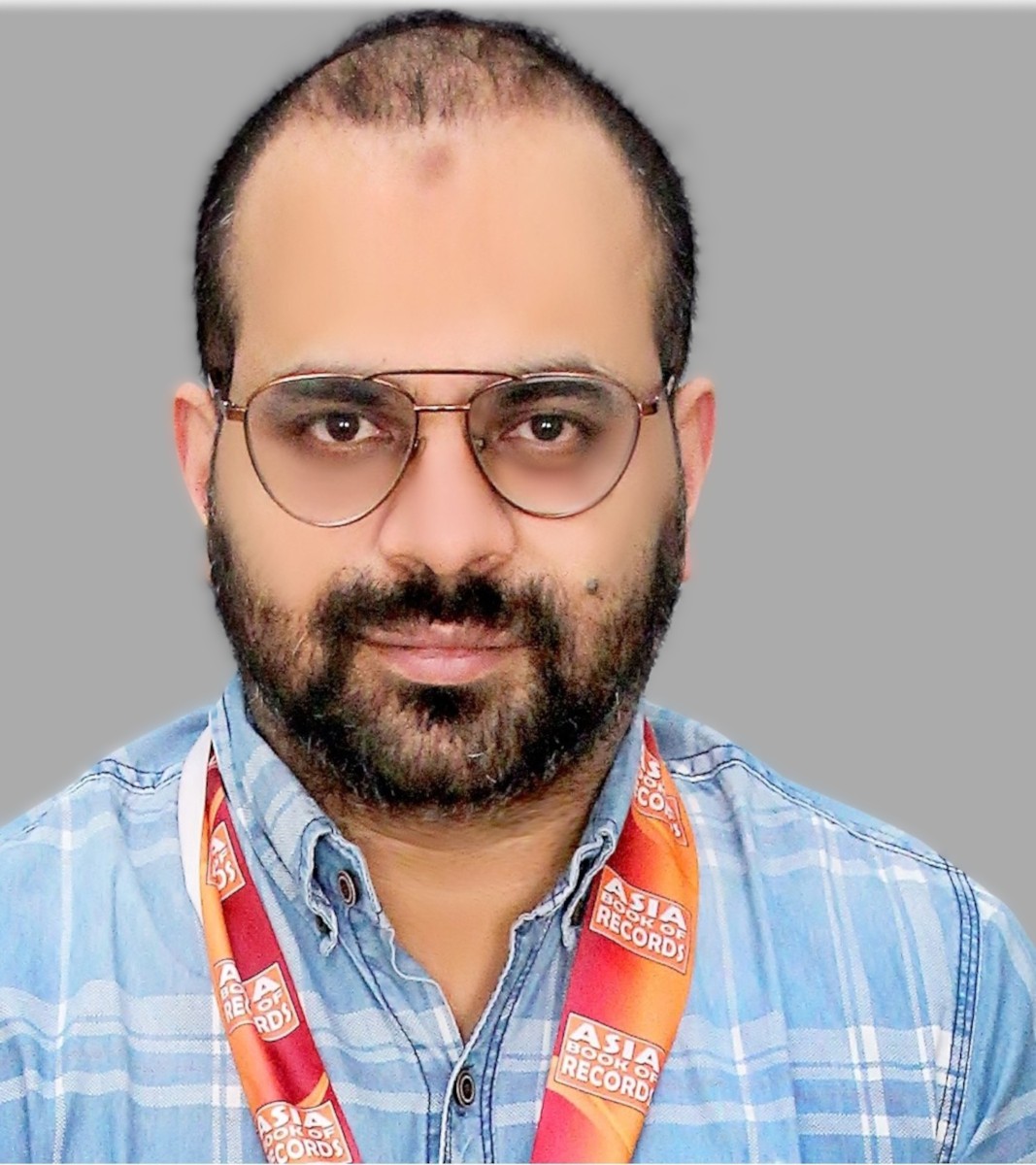
AZHAR UL HAQUE SARIO
Session Speaker
Cambridge alumnus, data scientist, and globally recognized hyper-prolific author possessing unmatched expertise in publication mechanics, speed, and consistency. Blending rigorous academic frameworks (MBA, ACCA Knowledge Level) with advanced data modeling, I have successfully bridged the gap between complex research and accessible mainstream literature. My portfolio encompasses deeply technical treatises (e.g., The Mathematical Architecture of the ArtificialPancreas) alongside cultural, historical, and financial masterworks.
A Comprehensive Framework for Artificial Intelligence: Bioinformatics and Computational Biology The landscape of artificial intelligence is vast, rapidly evolving, and increasingly central to solving the grand challenges of modern science. As we stand at the intersection of computer science and biology, understanding the full spectrum of AI is no longer just an advantage; it is a necessity. This presentation, drawn from the book A Comprehensive Framework for Artificial Intelligence: A Synthesized Curriculum, provides a structured roadmap of AI methodologies and demonstrates their transformative power in bioinformatics and computational biology. To build intelligent systems capable of deciphering biological complexity, we must first understand the foundational paradigms of AI. The historical journey of AI shows a shift from rigid, rule-based logic to systems that thrive in the messy, unpredictable real world. Biological data is inherently noisy and incomplete. Therefore, our presentation emphasizes the critical shift toward probabilistic reasoning and reasoning under uncertainty. We will explore how tools like Bayesian Networks allow us to model complex diseases by connecting symptoms, lifestyle habits, and genetic predispositions into a coherent map of probabilities. Furthermore, we will delve into dynamic models such as Hidden Markov Models (HMMs), which have become foundational in bioinformatics. HMMs are perfectly suited for sequential data, making them incredibly powerful for annotating DNA strands, identifying coding regions (exons) and non-coding regions (introns), and performing accurate gene finding. Beyond probabilistic models, the machine learning revolution has provided researchers with unprecedented tools to discover hidden patterns in massive biological datasets. We will demystify core machine learning concepts, illustrating how unsupervised learning techniques like clustering—often used to group similar data points together without pre-existing labels can be applied to segment patient populations or discover novel genetic groupings. Finally, the presentation will address the frontiers of modern AI: Deep Learning. The convergence of Big Data, powerful GPUs, and refined algorithms has allowed neural networks to achieve superhuman feats. We will highlight the impact of Convolutional Neural Networks (CNNs) in computer vision, demonstrating how they are trained to read medical scans like X-rays and MRIs to detect signs of diseases such as cancer with expert-level accuracy. We will also discuss monumental breakthroughs like DeepMind's AlphaFold, which utilized advanced AI to solve the 50-year-old grand challenge of protein folding, a milestone poised to accelerate drug discovery and molecular biology. By synthesizing these diverse AI domains—from classical search and logic to modern deep generative models—this presentation offers researchers a unified framework. It aims to equip the bioinformatics community with a clear understanding of which AI tools are best suited for specific biological problems, ultimately fostering the next generation of computational discovery.