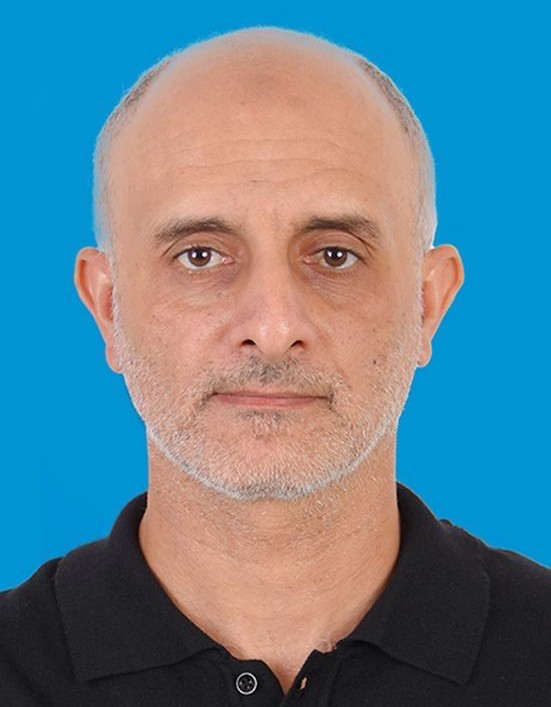
Dr. Azzam Abuhabib
Session Speaker
Civil Engineer and Water Security Expert with 26 years of cross-sectoral experience spanning academia, United Nations operations, and international consulting. Currently serving as Senior Lecturer at Universiti Teknologi Malaysia (UTM), specializing in Al-driven membrane desalination and wastewater treatment research (h-index 10, 459+ citations, reviewer for 8+ ISI journals). Former Senior Projects Officer at UNRWA, managing multi-million-dollar donor portfolios and leading emergency WASH responses during the 2014 and 2023 Gaza conflicts. Certified international trainer in disaster risk reduction, emergency management, and occupational safety. Proven track record in securing research funding, supervising 12+ Master's students, examining 25+ dissertations, and delivering 700+ hours of capacity-building training across 15+ organizations globally.
Bridging Mechanics and Data Science: Advanced Artificial Intelligence Applications in Nanofiltration Water Treatment and Desalination Abstract: Nanofiltration membranes have found applications in various industries, but water applications remain at the heart of these industries. Amongst, desalination and wastewater treatment as well as the capacity to remove other substances from water are the common applications. These membranes are Characterized by both high rejection of diverse substances depending on their molecular composition and charge, and high flux, demonstrating high potentials with long maintained performance. However, NF membrane scalability and reliability are intrinsically constrained by non-linear phenomena like complex solute-rejection mechanisms, long-term fouling dynamics, and the inherent flux–selectivity trade-off. Traditional mechanistic models relying on simplifying assumptions within the solution–diffusion framework, often fail to accurately predict performance in heterogeneous, real-time water matrices, leading to a critical divergence between predictive capability and operational reality. This research addresses this gap by comprehensively assessing the integration of machine learning (ML) across three main areas: fabrication optimization, performance prediction, and fouling diagnosis and mitigation. In addition, key challenges including data scarcity and heterogeneity, and lack of robust external validation are highlighted and discussed. Keywords: Nanofiltration, membrane, machine learning, desalination, wastewater treatment.