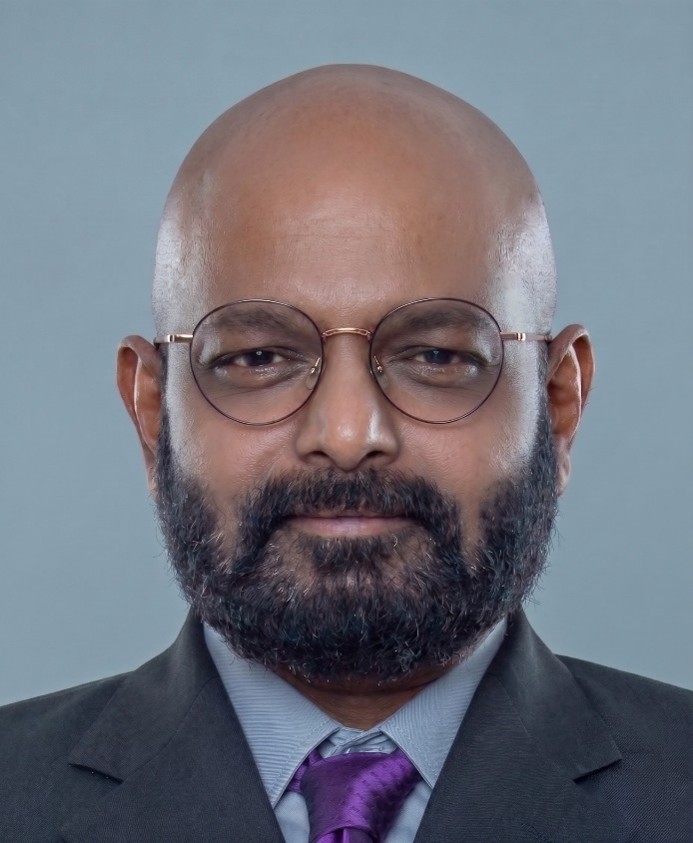
Selvakumar Manickam
Invited Speaker
Dr. Selvakumar Manickam is a leading authority in cybersecurity and AI. As a professor in cybersecurity & AI and the director of Cybersecurity Research Centre (CYRES) at USM, he has been instrumental in advancing security and privacy research. His contributions have significantly shaped algorithms and models that address complex challenges in cybersecurity. Dr. Selva's passion lies in forging connections between theory and practice, often by integrating cybersecurity and AI technologies. Equipped with decades of software development expertise, he also spearheads cutting-edge projects in automation, optimizing efficiency and safety across diverse sectors, including manufacturing energy, and agriculture.
His work has catalyzed significant improvements in productivity and security, showcasing the transformative potential of AI in real-world applications. A prolific researcher and author, Dr. Selva consistently publishes in top-tier journals and presents at prestigious conferences. He has cultivated a new generation of experts in the hybrid field of AI and cybersecurity. His insights are highly valued by journalists and industry leaders, solidifying his reputation as a thought leader in cybersecurity and AI. Dr. Selva's dedication to pushing the boundaries of knowledge makes him an influential figure in shaping the future of these critical fields.
Title
The Grid Under Siege: Confronting Cyber Threats to Critical Energy Infrastructure
Abstract
Modern energy infrastructure is no longer purely physical. The integration of digital technologies, distributed energy resources, and intelligent grid systems has transformed how power is generated, managed, and delivered. While these advances bring significant efficiency and sustainability gains, they also introduce complex and expanding cybersecurity vulnerabilities that adversaries are increasingly equipped to exploit.
Critical energy infrastructure has emerged as a high-value target for state-sponsored actors, cybercriminal groups, and hacktivists alike. Attacks on operational technology environments, industrial control systems, and distributed energy resources can trigger cascading failures with consequences that extend far beyond the energy sector, threatening public safety, economic stability, and national security. Yet many energy operators continue to rely on legacy systems designed without cybersecurity in mind.
Addressing this challenge demands more than technical patching. It requires a comprehensive approach encompassing secure-by-design principles, robust regulatory frameworks, cross-sector information sharing, and a skilled workforce capable of defending converged IT and OT environments. Building cyber resilience in the energy sector is not merely a technical priority; it is a matter of national and regional security.