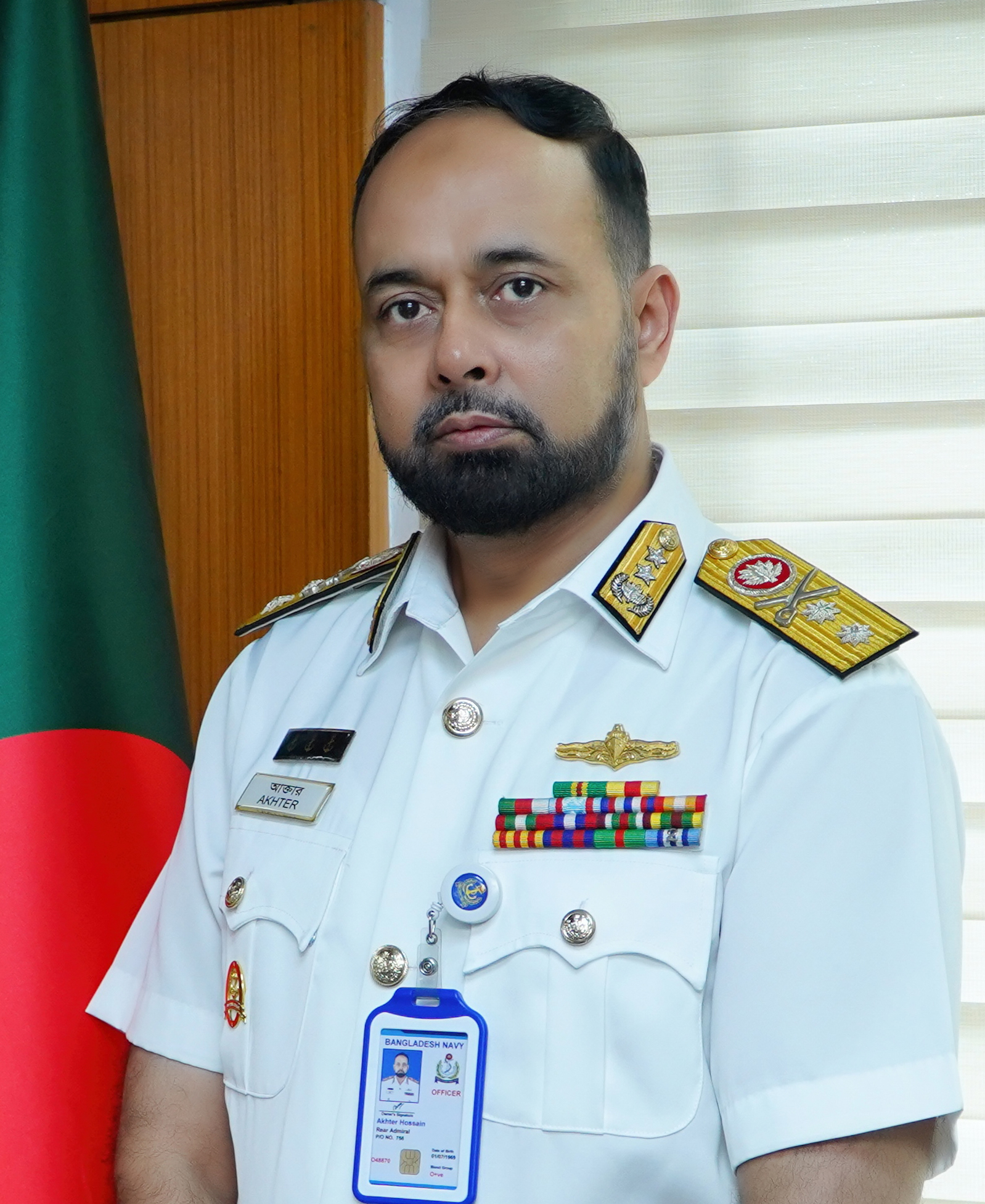
Rear Admiral Dr. Khandakar Akhter Hossain
Invited Speaker
Rear Admiral Dr. Khandakar Akhter Hossain is the Vice Chancellor of Bangladesh Maritime University and a distinguished senior officer of the Bangladesh Navy with extensive expertise in naval engineering, maritime education, shipbuilding, and advanced technologies. He was commissioned into the Engineering Branch of the Bangladesh Navy on 1 January 1991.
He earned both his B.Sc. and M.Sc. in Naval Architecture and Marine Engineering with distinction from the Bangladesh University of Engineering and Technology (BUET) and subsequently completed his Ph.D. at BUET. Throughout his career, he has undertaken advanced education, professional development, and specialized technical training in the United Kingdom, Germany, the United States, China, Japan, Australia, and several European countries.
During his naval career, Rear Admiral Dr. Hossain served as Chief Engineer aboard various naval ships and bases, including modern missile corvettes and frigates. He has also held numerous academic leadership positions, serving as an instructor at the Bangladesh Naval Academy, Marine Academy, National Institute of Technology (NIT), and the Military Institute of Science and Technology (MIST), where he later became the Dean and Head of the Naval Architecture and Marine Engineering Department.
He played a key role as the Chief Naval Architect and Engineer in the design and construction of the SHADHINOTA-class missile corvettes for the Bangladesh Navy while working at Wuchang Shipyard Ltd. in Wuhan, China. His professional experience also includes service as a United Nations Peacekeeper in Sudan, contributing to international peacekeeping operations.
Rear Admiral Dr. Hossain served as Member (Engineering) of the Chittagong Port Authority (CPA), where he contributed significantly to major national infrastructure projects, including the Bay Terminal, Matarbari Deep Sea Port, implementation of the International Ship and Port Facility Security (ISPS) Code, and initiatives that helped position Chittagong Port among the world's top 100 container ports recognized by Lloyd's Register.
He has successfully led all three major Bangladesh Navy-operated shipbuilding industries—Chittagong Dry Dock Limited (CDDL), Dockyard & Engineering Works Limited (DEW), and Khulna Shipyard Limited (KSY)—as Managing Director, making substantial contributions to Bangladesh's shipbuilding and ship-recycling sectors. He also served as Area Superintendent Dockyard, overseeing fleet maintenance, planning, and operational readiness of the Bangladesh Navy.
Before assuming the position of Vice Chancellor, he served as the Assistant Chief of Naval Staff (Materiel) at Bangladesh Navy Headquarters.
An accomplished researcher, Rear Admiral Dr. Hossain has authored hundreds of international publications, including research papers, books, and journal articles covering a wide range of disciplines such as Artificial Intelligence (AI), Internet of Things (IoT), Machine Learning (ML), Blockchain, Cryptocurrency, Robotics, Smart Cities, Astrophysics, Cosmology, Shipbuilding, Ship Recycling, Heavy Industry, Satellite Communication, Fourth Industrial Revolution (4IR), Automation, Quantum Technology, Energy Solutions, Education, Human Resource Development, Port Operations, and other emerging technologies. His scholarly work is widely indexed and available through Google Scholar, while many of his books are published through major international platforms.
He is a Fellow of several prestigious professional organizations, including the Institution of Engineers, Bangladesh (IEB), the Royal Institution of Naval Architects (RINA), United Kingdom, and the International Association of Maritime and Shipping Professionals (IAMSP), USA.
Rear Admiral Dr. Khandakar Akhter Hossain is married to Dr. Sharmin Hasan and is the proud father of twin daughters and two sons. He continues to contribute to maritime education, engineering innovation, research excellence, and national development through his leadership, academic contributions, and commitment to advancing science and technology.
Title : Evaluation of Feasibility and Reality of Smart Port Perspective for Bangladesh
Abstract : A seaport constitutes a maritime infrastructure equipped with docks, cranes, and storage facilities designated for international trade purposes, where vessels undertake the loading and unloading of cargo, containers, and passengers. In contemporary times, seaports serve as indispensable hubs for global commerce, facilitating the importation and exportation of a wide array of commodities. As the primary interface between nations, ports play a pivotal role in the global economy, with in excess of 75% of international trade transiting through them. The fundamental functions of seaports encompass operations, surveillance, handling of cargo and containers, customs procedures, warehousing, transportation, ship services, and security measures. Notable ports such as Houston, Los Angeles, Shanghai, PSA, DP World, and Rotterdam manage substantial volumes of goods promptly across the globe. Simultaneously, ports within Bangladesh, including Chattogram, Mongla, Payra, and Matar-Bari, are critical to regional commerce. The efficacy of ports is reflected in their ability to fulfill defined objectives effectively. Presently, smart ports are markedly efficient, as they incorporate assessments that optimize operational, managerial, and cost-related benefits. Recognizing the potential of smart ports is essential, given that even minor disruptions in cargo movement at major maritime ports can exert far-reaching effects. Furthermore, technological advancements are enhancing maritime navigation and environmental monitoring. This study underscores existing research gaps within Bangladesh’s port sector and aims to evaluate the benefits and challenges associated with smart ports for Bangladesh, alongside strategies for their effective implementation and development