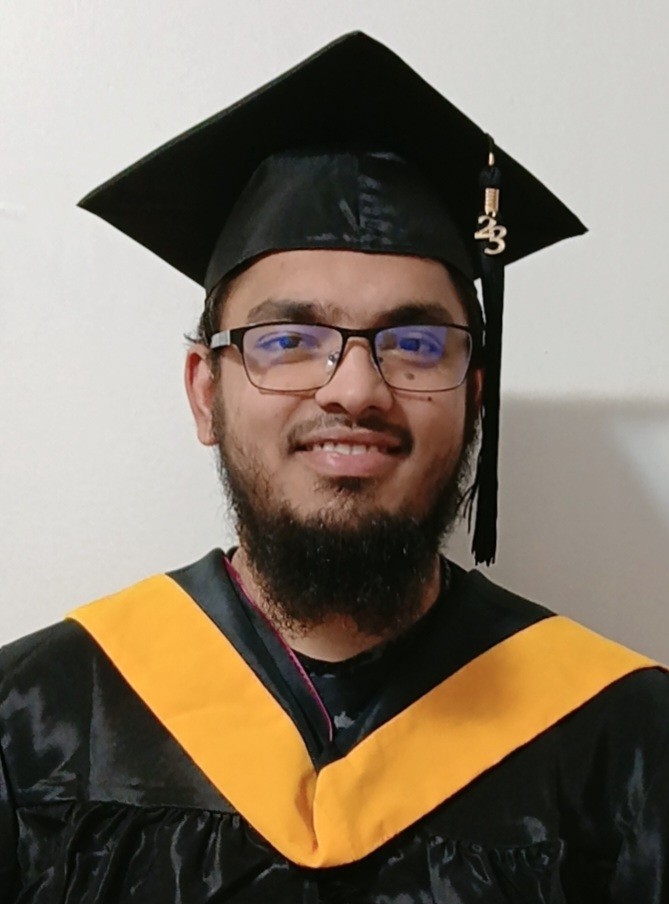
Md Fahim Ahammed
Keynote Speaker
Md Fahim Ahammed, M.S.
Senior Information Security Analyst & Cybersecurity Researcher
Md Fahim Ahammed is a cybersecurity researcher and information security professional specializing in AI-driven zero-trust architectures, adaptive threat detection, and privacy-preserving cryptographic computation. He holds a Master of Science in Information Assurance and Cybersecurity from Gannon University and brings hands-on expertise in enterprise security operations spanning SIEM platforms, cloud identity management, and zero-trust implementation across regulated environments.
Mr. Ahammed peer-reviewed research on AI-driven cyber threat detection and Secure Multi-Party Computation has been cited over 100 times by independent researchers across six continents, including work published in IEEE, Nature Portfolio, Oxford Academic, Wiley, and Elsevier journals. His methodologies have been adopted in applications ranging from healthcare AI and federal fraud prevention to Internet of Vehicles security and government-funded energy policy research.
Mr. Ahammed serves on the editorial board of a peer-reviewed cybersecurity journal and has held peer review and committee leadership roles at IEEE and Springer-published international conferences. He is the recipient of the Cyber Defense and Threat Intelligence Award at the International Universal Innovator Leadership Awards 2026, organized in association with London Metropolitan University.
Title: Securing the Intelligent Cloud: AI-Driven Zero-Trust Architectures, Privacy-Preserving Machine Learning, and Continuous Authentication for the Next Generation of Digital Infrastructure - ABSTRACT:
As organizations accelerate their migration to cloud-native environments and deploy increasingly sophisticated machine learning systems, the security models that once protected traditional perimeter-based infrastructure have become fundamentally inadequate. Static authentication, perimeter firewalls, and point-in-time identity verification cannot defend against the behavioral complexity of modern adversaries operating across distributed, dynamic cloud ecosystems. This keynote presents a unified framework for rethinking cloud security through three interconnected lenses: adaptive zero-trust architecture, privacy-preserving machine learning, and AI-driven continuous authentication.
The first dimension addresses the architectural shift from perimeter-based to identity-centric security. Drawing on research into AI-driven adaptive zero-trust models for critical infrastructure and defense networks, this talk examines how continuous verification principles — never trust, always verify — can be operationalized across heterogeneous cloud environments without introducing prohibitive latency or operational complexity. The integration of machine learning into the zero-trust decision engine moves security posture from static policy enforcement to dynamic, context-aware risk assessment.
The second dimension confronts one of the most consequential tensions in modern ML deployment: the need for collaborative data analysis across institutional boundaries where privacy regulations prevent raw data sharing. This talk presents advances in Secure Multi-Party Computation (SMPC) as a cryptographic foundation for enabling joint computation over sensitive datasets — allowing organizations, agencies, and research institutions to collaborate on fraud detection, healthcare analytics, and threat intelligence without exposing the underlying data of any participating party.
The third dimension introduces Privacy-Preserving Biometric Telemetry (PPBT) as a practical mechanism for continuous authentication in cloud-based systems. By training Recurrent Neural Network and Long Short-Term Memory architectures on non-invasive behavioral signals — interaction timing, navigation patterns, and session dynamics — rather than biometric identifiers, PPBT enables persistent identity verification throughout a session without collecting personally identifiable information. This approach addresses the specific vulnerability that synthetic identity fraud exploits in cloud-hosted government and enterprise systems: the gap between initial authentication and everything that follows.
Together, these three pillars form a coherent security architecture for the intelligent cloud — one in which machine learning does not merely detect threats after the fact, but continuously enforces trust, preserves privacy, and closes the authentication gaps that adversaries depend on. Attendees will leave with actionable frameworks, open research questions, and a concrete roadmap for implementing privacy-first, AI-native security in their own cloud environments.