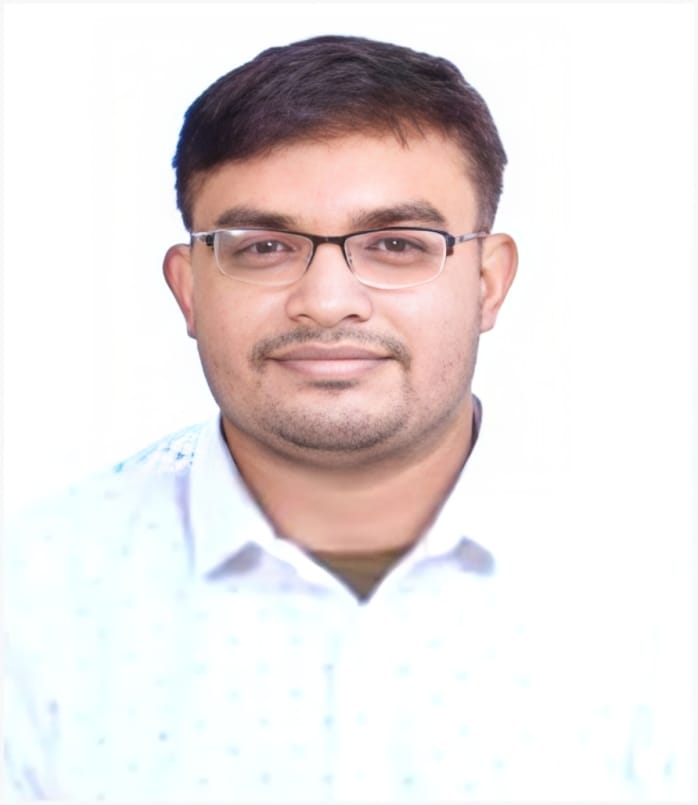
Vijendra Singh Tanwar
Session Speaker
Vijendra Singh Tanwar is a Civil and Structural Engineering professional and researcher with a B.Tech in Civil Engineering and an M.Tech in Structural Engineering from Rajasthan Technical University, Kota. He has also pursued a full-time Ph.D. at CSIR–CRRI, Delhi, and is currently working as a Senior Research Fellow at CSIR–Central Building Research Institute (CBRI), Roorkee. His research interests include sustainable building technologies, structural and heritage structure analysis, advanced construction materials, environmental and geotechnical engineering, wastewater treatment, biochar-based materials, and soil and ground improvement.
He has professional experience as a Site Engineer with Pawan Builders, Junior Engineer with Nagar Nigam (North), Kota, Junior Civil Engineer, and Faculty at Rajasthan Technical University. He is proficient in AutoCAD, STAAD.Pro, MX-Road, and PLAXIS 2D. His research and innovation activities include several design and UK patents related to AI-based carbon pollution detection, wastewater and plastic recycling, IoT-based wastewater treatment, biochar technology, air purification, and sustainable construction materials. He has also participated in various national and international technical webinars and CSIR research programs. His multidisciplinary work reflects a strong commitment to developing innovative, sustainable, and technology-driven solutions for civil engineering and environmental challenges.
Ultrasound-Assisted Modified Sewage Sludge Biochar for Soil and Water Treatment Applications: A Short Review
ABSTRACT
In this Paper latest progress (20182025) in the synthesis and utilization of ultrasound-assisted modified sewage sludge biochar (US-SSB) in soil and water remediation have been discusses. Due to growing interest in sustainable waste treatment and environmental purification, sewage sludge-derived biochar has been suggested as an efficient option. Nevertheless, its efficacy is usually hampered by low porosity and low surface activity. Ultrasound-assisted modification methods have become popular as an economical and effective way to improve biochar properties, such as surface area, functional group activation, and contaminant adsorption capacity. Research from 2018 to 2025 illustrates that ultrasound pretreatment or post-treatment greatly enhances the physicochemical properties of sewage sludge biochar, increasing its effectiveness in removing heavy metals (e.g., Pb, Cd, Zn) and organic pollutants (e.g., dyes, pharmaceuticals) from water. Likewise, in soil treatments, US-SSB has proven to be capable of improving nutrient retention, limiting metal mobility, and enhancing microbial activity, with the result of improved soil fertility and lower environmental risks. Key findings, efficiencies of treatment, modification parameters (ultrasonic frequency, power, and time), and environmental implications are underscored in this review, together with gaps of large-scale deployment and long-term stability. The combination of ultrasound technology with biochar production is a promising pathway for the transformation of municipal waste into high-performance materials for environmental remediation.