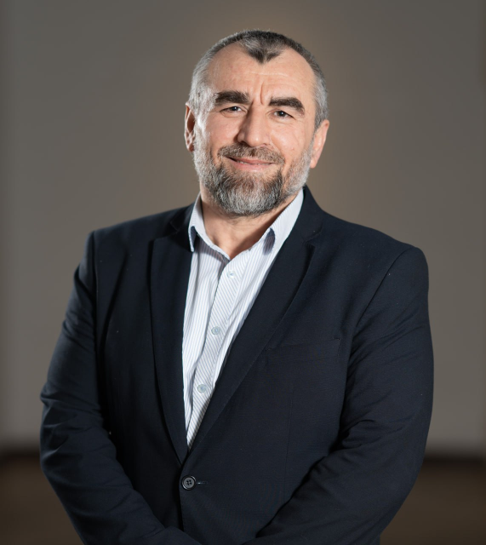
Dr. Fatmir Shehu
Session Speaker
DR. FATMIR SHEHU, an Albanian scholar, is currently an Associate Professor at the Department of Usul al-Din and Comparative Religion and Philosophy (RKUD), International Islamic University Malaysia (IIUM). His B.A. and M.A. were in Arabic Language/Linguistics, and his Ph.D. (Doctor of Philosophy in Usul al-Din and Comparative Religion, IIUM, Malaysia). His Ph.D. research was on ‘Nostra Aetate and the Islamic Perspective of Inter-Religious Dialogue’. Fatmir was a Deputy Director at the International Institute for Muslim Unity (IIMU), IIUM (2021-2023), and HOD, RKUD-IIUM (2017-2017). He taught and supervised for more than 18 years at the Undergraduate, Diploma, and Postgraduate levels. His research focus is on Islam and others, Qur’ānic and Sunnah Studies, Inter-Religious Dialogue, Comparative Religion, Ethics, World Religions, Theology, Cultural Studies, Women Studies, and Peace and Tolerance Studies. Fatmir has presented at many international and local conferences, seminars, forums, and webinars. He has authored/co-authored 48 articles, authored/edited 7 Books, and authored 12 Book Chapters. Also, he is an instructor for the online Postgraduate Diploma and Master Programme under the Institute of Knowledge Integration, Georgia.
Gender Equity through the Exemplary Personality of Maryam (Mary): A Comparative Study of Selected Qur’ānic and Biblical Texts
Abstract
This paper explores gender equity through a comparative analysis of the exemplary personality of Maryam (Mary) as portrayed in selected Qur’ānic and Biblical Texts. It aims to examine selected passages from religious sources on the personality of Maryam (Mary), highlighting her exemplary characteristics of dignity, faith, moral strength, and spiritual excellence. The significance of this study lies in presenting an inspiring female figure, Maryam (Mary), who stands out as one of the most honoured women in both Islam and Christianity, as a role model for contemporary women. In both religious sources, she is presented as a powerful example of faith, resilience, purity, and unwavering trust in God. This research adopts a qualitative comparative approach by examining key passages from Sūrat Āl ʿImrān and Sūrat Maryam alongside relevant accounts in the Gospels of Matthew and Luke. The discussion focuses on four interconnected themes: Maryam (Mary)’s unique status, her moral integrity and chastity, her complete trust in and submission to God’s will, and her enduring role as a model of faith and perseverance. Despite differences in theological interpretation, both the Qur’ān and the Bible portray Maryam (Mary) as a woman of remarkable character whose life challenges narrow assumptions about the role and value of women. Her story reflects fundamental principles of human dignity, spiritual equality, moral responsibility, and God-consciousness. Rather than presenting women as passive figures, both sources highlight Maryam (Mary)’s strength, courage, and central role in God’s divine plan and wisdom. Through a comparative analysis of these religious passages, this work demonstrates how the shared legacy of Maryam (Mary can contribute to contemporary discussions on women’s gender equity, inter-religious dialogue, and ethical leadership. This research paper is expected to conclude that Maryam (Mary) remains a timeless source of inspiration whose life encourages justice, mutual respect, compassion, and a deeper appreciation of women’s vital contributions to family and society from the perspectives of the selected Texts from the Qur’ān and the Bible.
Keywords: Maryam (Mary), Women’s Gender Equity, the Qur’ān, the Bible, Comparative Scriptural Analysis, Human Dignity, Interreligious Dialogue.