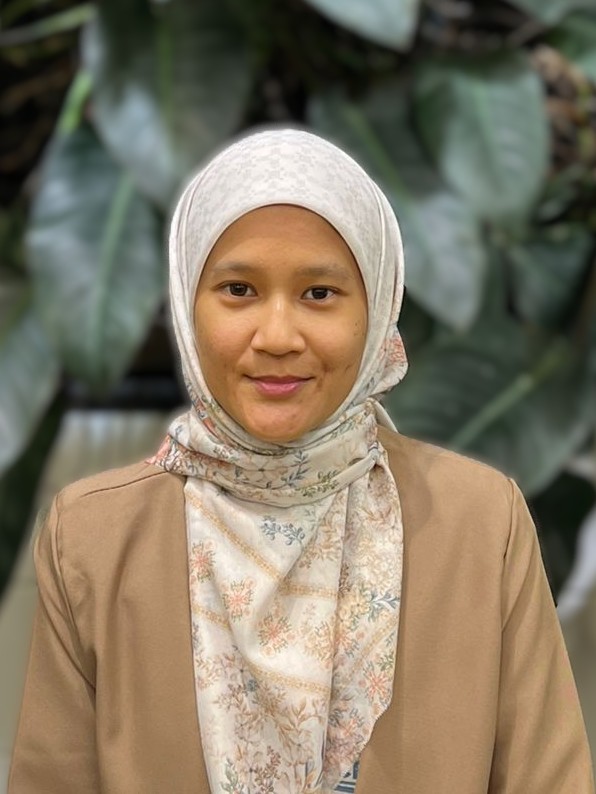
Izzati Binti Mohd Tohid
Session Speaker
Dr. Izzati Mohd Tohid is a Psychology and Organizational Transformation Professional with 14 years of multidisciplinary experience in coaching psychology, human behaviour, change management, digital transformation, AI adoption, mental health, and inclusive leadership. She combines psychology-informed practice with structured transformation strategies to support employee readiness, behavioural change, psychological safety, and sustainable technology adoption.
Her professional experience spans organizations including PRefChem, PETRONAS Digital, Billennium IT Services, the Malaysian Mental Health Association, and healthcare and community environments. She has led and supported enterprise transformation initiatives involving AI-enabled productivity, governance, risk and compliance, digital systems, stakeholder engagement, learning, and organizational change.
Dr. Izzati holds a Master of Business Administration in Project Management, a Bachelor of Education in Clinical, Counselling and Applied Psychology, and is pursuing doctoral research in Management and Administration. Her professional and research interests include women’s empowerment, digital resilience, responsible AI adoption, psychological safety, mental health and wellbeing, and human-centred organizational transformation.
PSYCHOLOGY • WOMEN • ARTIFICIAL INTELLIGENCE
Psychological Safety, Digital Resilience, and Women’s Empowerment in the Age of Artificial Intelligence
A Human-Centred Framework for Inclusive Transformation
Abstract
The rapid advancement of artificial intelligence and digital technologies is reshaping workplaces, professional identities, and opportunities for participation. Although these developments can expand access to knowledge, flexible work, and leadership pathways, they can also intensify psychological strain, confidence gaps, role uncertainty, and exclusion from technology-related decisions. These challenges are particularly important when considering women’s empowerment, because access to a digital tool does not automatically create the confidence, authority, psychological safety, or sense of belonging required to use it meaningfully.
This practice-based conceptual paper introduces a Human-Centred Psychological Empowerment Framework that integrates coaching psychology, counselling-informed practice, organizational change, behavioural adaptation, and digital-transformation experience. The framework proposes that sustainable empowerment in AI-enabled environments is shaped by five interconnected conditions: psychological safety, digital self-efficacy, adaptive resilience, empowered participation, and socially responsible reinforcement. Together, these conditions move the conversation beyond technology access toward women’s capacity to influence how technology is designed, introduced, governed, and evaluated.
The paper draws on multidisciplinary professional experience across organizational transformation, workplace learning, stakeholder engagement, mental-health advocacy, counselling practice, and AI-enabled productivity change in petrochemical, healthcare, research, and digital-services environments. These experiences suggest that people engage more constructively with change when they can ask questions without fear of judgment, understand how the change affects their identity and role, access relevant learning, receive supportive feedback, and observe leaders responding to concerns with transparency. Conversely, an exclusive focus on deployment speed and usage metrics may conceal anxiety, disengagement, unequal participation, and low psychological ownership.
The proposed framework translates these insights into five areas of practice. Psychological safety creates conditions for voice, experimentation, and learning. Digital self-efficacy strengthens confidence through accessible and role-relevant capability building. Adaptive resilience supports emotional regulation, cognitive flexibility, and healthy coping during uncertainty. Empowered participation positions women as co-designers, champions, decision-makers, and leaders rather than passive recipients of change. Socially responsible reinforcement connects individual wellbeing with leadership accountability, inclusive governance, and measurable community or organizational impact.
The presentation will offer practical diagnostic questions and indicators for leaders, psychologists, educators, policymakers, and transformation practitioners. Suggested indicators include perceived psychological safety, confidence in using new technologies, access to learning and peer support, representation in design and governance forums, ability to influence implementation decisions, and qualitative evidence of wellbeing and professional agency. The framework is presented as a practice-based model for discussion and future empirical validation, rather than as a completed causal study.
By connecting psychological science with digital-transformation practice, this paper argues that equitable innovation requires more than technological readiness. Women are meaningfully empowered when they possess the psychological resources, social support, capability, and decision-making influence to shape technological change. Embedding these conditions into AI-enabled transformation can strengthen wellbeing, leadership participation, sustainable adoption, and wider social impact.
Framework at-a-Glance
1 Psychological Safety
2 Digital Self-Efficacy
3 Adaptive Resilience
4 Empowered Participation
5 Responsible Reinforcement
The framework positions empowerment as a staged but interconnected process: women first need psychologically safe conditions to speak, learn, and experiment; they then require confidence and capability to use digital tools meaningfully; they must be supported to remain resilient during uncertainty; they should be enabled to influence decisions and implementation; and finally, organizations must reinforce inclusive, responsible practices through leadership accountability and measurable impact.
Framework Element What It Means Practice Focus Indicative Measures
1. Psychological Safety The emotional and social condition that allows women to ask questions, raise concerns, challenge assumptions, and try new approaches without fear of judgment or exclusion. Create open forums, normalize learning curves, encourage reflective dialogue, and train leaders to respond constructively to uncertainty and resistance. Perceived safety to speak up, quality of leader response, frequency of questions raised, and evidence of constructive feedback loops.
2. Digital Self-Efficacy Women’s belief that they can understand, use, and adapt digital and AI-enabled tools in ways that are relevant to their roles, goals, and professional identity. Provide accessible training, role-based examples, peer learning, coaching prompts, safe practice spaces, and confidence-building support beyond technical instruction. Confidence ratings, training participation, successful use cases, peer-support activity, and self-reported ability to apply tools independently.
3. Adaptive Resilience The capacity to regulate emotions, reframe uncertainty, sustain motivation, and maintain wellbeing while navigating technological and organizational change. Use coaching psychology, reflective practice, wellbeing check-ins, change-readiness conversations, and practical coping strategies to reduce overload and build flexibility. Change fatigue signals, wellbeing indicators, coping confidence, sustained engagement, and qualitative reflections on role clarity and emotional readiness.
4. Empowered Participation The shift from women being passive recipients of AI-enabled change to active contributors, co-designers, champions, decision-makers, and visible leaders. Include women in design workshops, pilot groups, governance discussions, communication planning, champion networks, and leadership storytelling. Representation in decision forums, influence on implementation choices, number of women champions, leadership visibility, and perceived agency.
5. Responsible Reinforcement The organizational mechanisms that sustain empowerment by linking individual wellbeing, inclusive governance, ethical AI use, and social or business impact. Embed accountability in leadership routines, review inclusion data, recognize responsible practice, evaluate unintended impacts, and connect adoption outcomes with wellbeing. Inclusive adoption outcomes, governance participation, wellbeing and impact evidence, responsible-use practices, and sustained behavioural change.
Keywords
Women’s empowerment • coaching psychology • psychological safety • digital resilience • artificial intelligence • self-efficacy • inclusive leadership • organizational transformation • social impact
Audience Takeaways
• A practical empowerment lens for AI-enabled change. Participants will gain a psychologically informed way to understand why women’s empowerment in digital transformation requires more than access to tools. The framework highlights the importance of safety, confidence, resilience, participation, and responsible reinforcement as conditions that help women engage with AI meaningfully and sustainably.
• Actionable strategies for leaders, educators, and practitioners. The session will offer practical approaches for strengthening psychological safety, building digital self-efficacy, supporting adaptive resilience, and creating opportunities for women to participate as co-designers, champions, and decision-makers in AI-related initiatives.
• Measures that go beyond adoption numbers. Participants will be introduced to indicators that complement technology-usage metrics, including perceived voice, confidence, wellbeing, peer support, leadership responsiveness, representation in governance forums, and evidence of professional agency.
• Reflection questions for immediate application. Audience members will leave with diagnostic questions they can adapt in their own workplaces, classrooms, communities, or policy settings, such as whether women feel safe to question AI decisions, whether training builds confidence as well as skills, and whether women have visible influence over implementation choices.
• A bridge between psychology and transformation practice. The takeaways connect coaching psychology, counselling-informed awareness, organizational change, and AI adoption practice, helping participants translate human-centred principles into practical design, communication, learning, and leadership routines.
• A basis for future research and validation. Researchers and policymakers can use the framework as a starting point for future empirical study, programme evaluation, or inclusion-focused policy design that examines how psychological conditions shape women’s empowerment in AI-enabled environments.