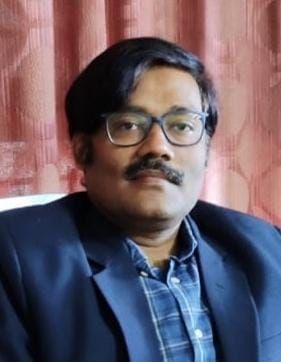
Akhlaque Ahmad 'Ahan'
Session Speaker
Akhlaque Ahmad ‘Ahan’ is Professor & Chairperson at the Centre of Persian and Central Asian Studies, Jawaharlal Nehru University, New Delhi, and formerly Visiting Professor at Tashkent Oriental State University, Uzbekistan. He has published more than thirty books and around one hundred research papers, supervised over fifty research works, organized national and international seminars, and travelled to many countries. He is internationally acclaimed bilingual poet (Persian & Urdu), published five poetry collections, and his poetry is part of curriculum and academic research in many countries.
Among the awards he received includes President of India’s Maharshi Badrayan Vyas Samman–2018; Delhi Urdu Academy Award-2011, Saadi Award, Tehran-2021; Harihar Dutt Award, Kolkata-2022, Muhammad Ali Jauhar Award-2024, International Qand e Parsi Award, London, UK-2025, and International Iqbal Award from ECO, Tehran-2015. He was invited by many Head of States as a Poet and scholar including Presidents of Tajikistan, Uzbekistan, Iran, Afghanistan, Governors of Navai, Khwarazm and Farghana (Uzbekistan), and many Institutions in USA, UK, and Persian and Central Asian Countries. Documentary films have been made by Sahar TV and Sada o Sima TV, Iran and DD Urdu focusing on his poetry and academic contributions. He has been part of many documentaries and appears regularly on various TV channels and Radio talks in India and abroad.
Reflections of Socio-Political Change in the Contemporary Iranian Women Writing
Akhlaque Ahmad ‘Ahan’
Professor & Chairperson, Center of Persian and Central Asian Studies,
Jawaharlal Nehru University, New Delhi-110067
Abstract
During last hundred years Iran has gone through tremendous socio-political and cultural changes. Constitutional historiography has positioned the beginning of the growing women’s liberation movement in Iran as a derivative of the 1905-11 constitutional revolutionary period. This standard narrative, however, overlooks the evidence that the roots of the modern movement stretch farther back to the early 1800s.
The origins of the Iranian women’s movement can be traced to girls’ education and women’s public political activity, started with the beginning of girls’ schools in the early 19th century. This led to the wider awareness among Iranian women with respect to ethnicity, religion, lifestyles, life expectancies, and cultural values, and a mostly middle and upper class urban female reaction and expression of a change in individual and national consciousness
The tradition of women’s writing in contemporary Iran is thus one of radical dissent and questioning. It is the chronicle of an evolving consciousness; the testament of efforts to makes lives according to new values and standards. It is the cries of mutinous women confronted and the terrible odds against which they attempted to write reveal the strength and the value of their literary achievements. Perhaps, that is why many Iranian women have rejected the possibility that their works can be understood in isolation from their restricting contexts of the hardships, sufferings, and anxieties that have dominated their lives.
Regardless of the obstacles offered by a society that identified woman as wife and mother and idealized her invisibility and voicelessness till the end of the nineteenth and early twentieth century, however, during the same era and later in the 20th and 21st century, a tradition of assertion of women writing came to be established in Iran. Self-defending and self-articulating women poets and writers such as Tahereh Qorratol`Ayn (1814-1852), Parween E`tesami (1907-1941), Forough Farrokhzad (1934-1967), Simin Daneshvar (1921-2012), Simin Beh’bahani (1927-2014), Shahrnush Parsipur (1946-2026), and many others lifted the taboo of secrecy to show the many faces of realities of Iranian society underneath. Through their writings we may sense the change happening within the society at many levels. They have explored, explained and expressed the agony, suffocation and aspirations of men and women of the surrounding.
Key Words: women’s liberation movement in Iran, women’s writing, contemporary Iran, women poets and writers, socio-cultural changes.