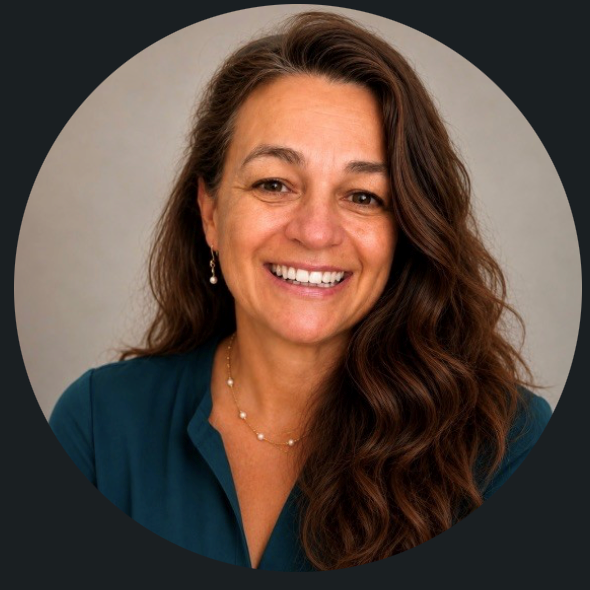
Dr. Estela Lutero
Invited Speaker
Dr. Estela Lutero is an economist, researcher, educator, and international development specialist with more than 25 years of experience across Brazil, Canada, Europe, and Asia. She holds a Ph.D. in Development and Sustainability from the University of Campinas (UNICAMP) and has worked across government, academia, international research, public policy, and community development.
Her work focuses on women’s empowerment, sustainable development, public policy, ethical leadership, community resilience, and new economic approaches grounded in human dignity and the common good. She has held senior roles with the Government of Canada, Statistics Canada, Infrastructure Canada, and international research institutions.
Dr. Lutero is an active contributor to the Economy of Francesco. In 2025, she received First Place for Best Scientific Paper at the Economy of Francesco Conference in Portugal. In 2026, she presented research in Norway on reclaiming the spiritual dimension of economic decision-making.
Her current work includes Living Waters, a community-based initiative supporting Maasai women through water access, entrepreneurship, sustainable livelihoods, local leadership, and community resilience.
Living Waters: Trust Across Oceans as a Pathway to Maasai Women’s Empowerment
Abstract: Women’s empowerment is often discussed in terms of economic opportunity, access to resources,and participation in decision-making. Yet, for women in rural communities, empowerment can begin with something as fundamental as access to water. The Living Waters Project, developedthrough the Economy of Francesco in partnership with Enduata Emaa, a Maasai community based organization in Kenya, explores how trust-based international partnership can contribute towomen’s empowerment through water access, entrepreneurship, food security, and collective action.
The project began with a relationship of trust between partners living thousands of kilometresapart. Rather than imposing an externally designed intervention, the partnership responded tolocally identified needs and supported community-led solutions. Improved access to water has reduced the physical burden of carrying water over long distances, particularly for women, while enabling productive activities such as kitchen gardening. Thirty women are directly involved in managing the kitchen gardens, which have contributed to improved nutrition among women and children.
The project has also supported women’s economic participation through entrepreneurship activities involving two self-help groups: Naretoi Self Help Group, with 14 women, and Enduata Self Help Group, with 16 women, reaching 30 women directly. These groups strengthen
women’s collective organization, entrepreneurial capacity, and participation in community development.
The initiative has mobilized US$2,789, demonstrating how relatively modest resources can generate broader social and economic effects when grounded in trust, local leadership, and partnership. Importantly, the Maasai women are not positioned merely as beneficiaries. They are participants, organizers, producers, entrepreneurs, and decision-makers whose knowledge and priorities shape the project.
Living Waters suggests that women’s empowerment can be strengthened when development partnerships move beyond a donor-recipient model toward trust, reciprocity, and shared responsibility. The experience demonstrates that geographical distance does not have to be a barrier to meaningful collaboration. When trust crosses oceans, access to water can become a pathway to greater dignity, economic participation, food security, and community resilience.
Keywords: women’s empowerment; Maasai women; water access; entrepreneurship; community development; trust; social capital; Kenya; international partnership.