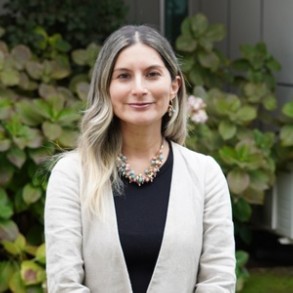
Dr. Paulina Santander Astorga
Session Speaker
Paulina Soledad Santander Astorga is a Chilean psychologist and researcher with a PhD in Psychology from Pontificia Universidad Católica de Valparaíso. She serves as Deputy Director of the Departamento de Estudios Humanísticos at Universidad Técnica Federico Santa María (UTFSM) and Head of its Social Sciences Area, where she teaches Feminist Theories and Gender Equity.
Her research focuses on gender equity in STEM, women's entrepreneurship, and feminist methodologies. She co-directs the Observatorio de Género en Ciencias e Ingeniería at UTFSM and leads the Research with Gender Perspective Axis for the InES de Género Project. Her work has been published in journals including Revista Estudos Feministas and Sustainability, and she has supervised over 60 theses.
Santander has held research stays in Spain and Mexico and has been recognized with awards including the Outstanding Women AGEP-V Award (2020) and the Beca Iberoamérica for Young Professors and Researchers (2015). She is based in Valparaíso, Chile.
Opening the Door is not enough: Sustaining Women in Science
Abstract: For decades, gender equity policies in science have focused on a necessary but insufficient goal: increasing the number of women entering scientific and academic spaces. Yet evidence from the Global South -particularly from Chile and Latin America- shows that access without accompaniment produces fragile permanence: women who enter, but who burn out,
withdraw, or are silently pushed out by institutional structures that were never designed to sustain them.
This presentation proposes a shift in focus from "access" to "permanence," understood not as an individual problem of resilience or merit, but as a structural and affective one. From a situated perspective in the Western Global South, I argue that women's retention in science requires at least three simultaneous transformations.
First, a politics of affect: recognizing that scientific trajectories are not only intellectual but also emotional, shaped by fear, shame, impostor syndrome, the overload of caregiving responsibilities, and the subtle forms of violence rarely named in the formal spaces of science. Sustaining women in science means building communities of care, genuine
mentorship, and spaces where distress can be voiced without being pathologized as individual weakness; second, a change in the institutional structures that organize scientific work:
evaluation criteria that do not penalize career interruptions due to motherhood or caregiving, productivity timelines that do not replicate masculinized competitive logics, and decision
making spaces where women are not merely present, but hold real power to influence outcomes; and,third, I propose thinking of scientific institutions as agents of social change, rather than as neutral spaces that simply mirror the inequalities of the societies they belong to. Universities and research centers have the capacity —and the responsibility— to actively
challenge the social structures that perpetuate gender inequality, rather than merely adapting to them. This means embracing gender equity not as an isolated human-resources policy, but as part of the institution's epistemological and ethical project.
Finally, I want to situate this reflection from the Western Global South -Chile and Latin America- in dialogue with the realities of Asia and the context in which this conference takes
place. Although our colonial, economic, and cultural histories differ, I share the hypothesis that many of the tensions between formal access and real permanence for women in science
cut across contexts shaped by institutional structures inherited from patriarchal and colonial logics. This presentation seeks to open a space for South-South and South-Asia exchange on
how to transform scientific institutions into active agents of gender justice, beyond quota policies or numerical access alone.
Key words: Gender equiality, STEM, scientific trajectories.