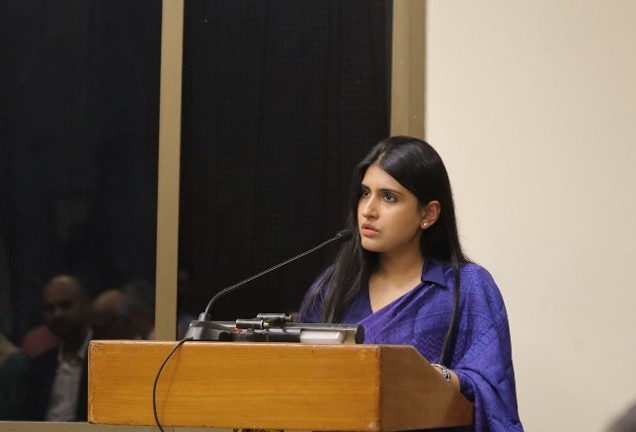
Ms. Manika Malhotra Jain
Session Speaker
Ms. Manika Malhotra Jain is an economics and policy research professional with over nine years of experience in research, policy analysis, project coordination, and development-oriented initiatives. She is currently engaged as Chief Coordinator with the New Delhi, India-based think tank, Policy Perspectives Foundation (PPF). She holds a postgraduate degree in Economics from TERI School of Advanced Studies and a Bachelor's degree in Economics from Delhi University. Alongside her professional engagements, she is currently pursuing doctoral research in the field of Business Economics and Management. Her work combines qualitative and quantitative research methodologies with a strong focus on governance, sustainability, social development, and policy implementation. Over the years, she has successfully led and coordinated multiple research, policy, and social development projects across sectors including child rights, women empowerment, sustainability, public health, governance, and inclusive development. She has been a lead researcher on several significant studies, including a comprehensive analysis of the implementation of the Protection of Children from Sexual Offences (POCSO) Act, 2012. She also authored a monograph on E-Waste Management: Policy Analysis and Implementation, focusing on reverse logistics, circular economy frameworks, and policy implementation in the Delhi-NCR region. Manika has co-edited books and written extensively on sustainability, women's safety, informal labour, FDI, and public policy. Her articles and policy commentaries have appeared in publications including The Hindu, The Indian Express, Firstpost, CNBC, and Business Standard. Her professional experience also includes consulting assignments with the Department of Administrative Reforms and Public Grievances (DARPG), Ministry of Home Affairs, in collaboration with the Vision India Foundation, along with engagements across academic and private sector institutions.
Abstract title : The Economics of Inclusion: From Gendered Participation to Economic Agency
Abstract : Women’s economic participation is a global concern, yet the relationship
between employment and empowerment remains complex. Despite
growing attention to gender equality and women’s economic inclusion,
women continue to face unequal care responsibilities, motherhood
penalties, occupational segregation and structural barriers to accessing and
sustaining paid employment. These challenges raise an important question:
when women’s participation in the labour market increases, does it
necessarily reflect greater economic opportunity and autonomy, or can
persistent inequalities shape the nature and quality of that participation?
This presentation examines the intersection of unpaid care and women’s
labour market participation, drawing on India’s experience from 2017–18
to the latest available data for 2025-26, while situating the discussion
within broader global debates on gender, work and development.
The presentation seeks to move beyond participation as a standalone
indicator of inclusion and consider what it reveals and what it may conceal
about women’s economic lives. By examining the relationship between
unpaid care, the nature of women’s work and the structural conditions
governing their employment choices, it questions whether existing
approaches to economic inclusion adequately account for the unequal costs
women bear in participating in the workforce. This discussion matters
because the distinction between being employed and being economically
empowered has implications for how progress towards gender equality is
measured, how labour markets are understood, and how economic policies
are designed. Ultimately, the presentation invites a broader reconsideration
of what meaningful economic inclusion entails and whether women are
being enabled to participate on equitable terms, rather than simply being
counted as participants.