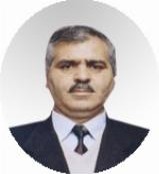
Mahammad A. Nurmammadov
Session Speaker
Mahammad A. Nurmammadov in present is Dr.Associated Professor, Lead scientific researcher of the Department of Theoretical Astrophysics and Cosmology after name N. Tusi Shamakhy Astrophysical Observatory of the Ministry Science and Education of Republic Azerbaijan Dr. Associate Professor Mahammad A. Nurmammadov graduated in Mathematics in 1987 from Novosibirsk State University's Department of Applied Mathematics, where he pursued a PhD in Physics and Mathematics with specializations in two areas: 1. Differential Equations and 2. Mathematical Physics. He will soon be presenter for defense second degree including equation of nonclassical mathematical physics for Doctor of Science degree, specializing in Astrophysics and Stellar Astronomy, with the topic approved by the Ministry of Science and Education of the Republic of Azerbaijan. He has worked at Novosibirsk State University (USSR), as the head of construction, and was head of department of the Special Construction Section (in National Academy of Sciences of Azerbaijan). Additionally, he served as Vice-Rector of Scientific Affairs at Lankaran State University and as an Associate Professor at the Oil Academy of Azerbaijan (Department of Applied Mathematics), as well as at Azerbaijan State Pedagogical University. He also headed the Department of Theoretical Astrophysics and Cosmology at the after-named N. Tusi Shamakhy Astrophysical Observatory of the Ministry of Science and Education of the Republic of Azerbaijan. Currently, he is the lead scientific researcher in the Department of Theoretical Astrophysics and Cosmology. Presently, his research includes two scientific directions: 1. Non-classical equations of mathematical physics and 2. Astrophysics and Stellar Astronomy. He has published 64 papers (one of them published and authored in Acta *Math. Appl. Sin. Engl. Ser.* 38, 763–777 (2022), Institute of Applied Mathematics, Academy of Mathematics and System Sciences, Chinese Academy of Sciences, Chinese Mathematical Society, Chine. He has solved degenerating systems of equations with singularities that arise in MHD (magnetohydrodynamic) waves and plasma in the Sun. He has applied new non-classical model approaches to Parker’s solar wind and magnetic field models. Recently, he has applied non-classical models of mathematical physics to some giant planets and magnetic star. He is the chief editor of the “International Journal of Partial Differential Equations and Its Applications,” the chief editor of the “Space Sciences Journal,” and an editor of the “American Journal of Astrophysics and Astronomy,” among 14 other journals (in America, Europe, India, etc.). 3 books (one of them printed in the USA, Outskirts Press, Inc.Denver, Colorado, Library Congress Control Number: 2008934491) and participations in more than 70 international scientific conferences (he is also a member of a scientific committee). In 2025, a member of the American Physics Society, USA. On another note, he has taught pure mathematics and applied mathematics subjects for 27 years at various universities in Azerbaijan and abroad, in Azerbaijani, English and Russian.
AN APPLICATION OF NON-CLASSICAL MATHEMATICAL PHYSICS MODELS TO THE PLANET SATURN FOR INVESTIGATION OF PLASMA AND MAGNETOHYDRODYNAMIC EQUILIBRIUM Since the title includes the terms “non-classical mathematical physics models",“plasma," and “magnetohydrodynamic equilibrium," we will provide a brief description of these terms as they pertain to our research. Mathematical physics models are termed “non-classical” if their formulation as equations or systems of partial differential equations does not fit within the framework of any classical types—elliptic, parabolic, or hyperbolic. In our case we consider the magnetohydrodynamic equilibrium to be a state in which all forces in the system are balanced: the magnetic pressure counterbalances the plasma pressure, the Lorentz force is countered by the pressure gradient, and centrifugal force is counterbalanced by other forces.Saturn’s moon Enceladus acts as a source of cold plasma, which then, under the influence of the solar wind, rotates synchronously with the hot plasma and mixes with it. The mathematical model takes into account the motion of the cold plasma, which, under the influence of the solar wind, rotates synchronously with the hot plasma and mixes with it in Saturn’s magnetosphere. For plasma model being to the elliptic-hyperbolic equations were derived, which belong to the class of nonclassical equations in mathematical physics. Furthermore, since the instability prevents the plasma from entering the magnetic field under the action of centrifugal force, the Euler potentials of the balancing forces are taken into account when modeling Saturn’s magnetic field to derive the stability conditions for its magnetohydrodynamic equilibrium.Furthermore, since instability prevents plasma from entering the magnetic field under the action of centrifugal force, the Euler potentials of the balancing forces are taken into account when modeling Saturn’s magnetic field to derive the stability conditions for its magnetohydrodynamic equilibrium and derived equations, we examine the plasmas and magnetosphere that ensure magnetohydrodynamic equilibrium and the rotational stability of Saturn. Keywords: magnetohydrodynamic equilibrium, plasma, non-clssical model of mathematical physics, Saturn, magnetosphere.