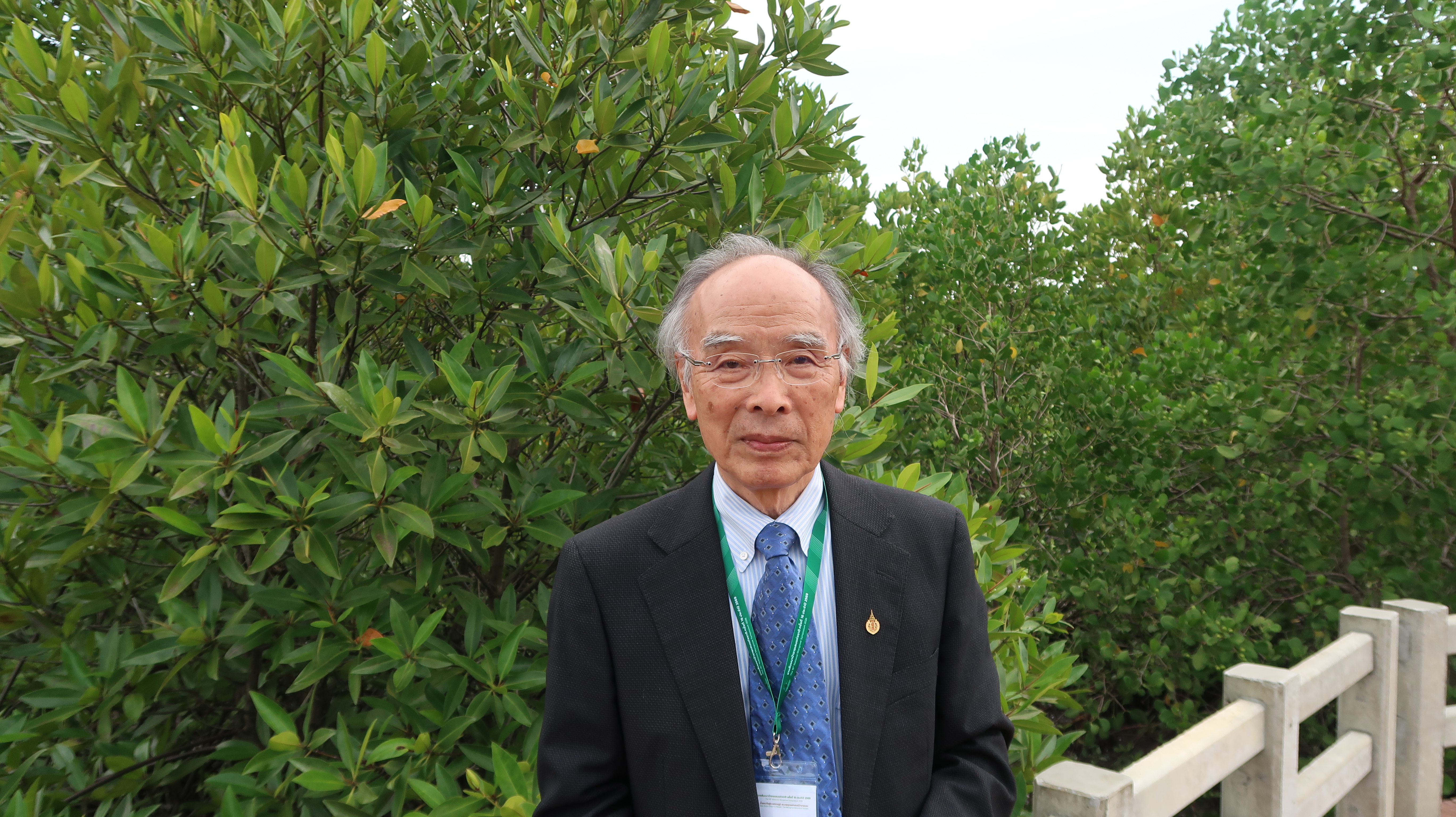
Dr. Shigeru Kato
Keynote Speaker
Dr. Shigeru Kato obtained his PhD in Agriculture from Tokyo University of Agriculture (TUA) in 1976. He has served in several academic and research positions, including Professor at the NODAI Research Institute, Tokyo University of Agriculture, and Special Invited Research Professor at Seikei University, Tokyo. In 2013, he received an Honorary Doctorate in Environmental Science from Walailak University, Thailand. His major research fields include Mangrove Research and Environmental Science, with over four decades of continuous contribution to these areas.
Mangrove Plantation in around Pak Phanang areas of Nakhon Si Thammarat for Restoration of Biodiversity and mitigation of Earth warming: Mangrove forests are very important ecosystems and the most productive ecosystems at subtropical and tropical region on Earth. Mangroves are providing critical ecosystem services including biodiversity support, coastal protection, and carbon sequestration/accumulation—the latter estimated at five times or more the capacity of terrestrial tropical rainforests. Despite their importance, Thailand’s mangroves suffered rapid decline between the 1970s and 1990s due to agricultural, fishery and industrial development. In Nakhon Si Thammarat Province, over 4,000 hectares were converted into shrimp farms, many of which were subsequently abandoned due to disease, water pollution and surrounding environmental degradation.
In response, the "Operation Green Carpet" initiative was launched in 1997 to restore these areas through community-led reforestation. To evaluate the success of this restoration, long-term ecological monitoring was conducted. Stable isotope analysis (13C and 15N) of fish communities in Pak Phanang Bay revealed a significant increase in food web complexity, with trophic nodes expanding from 7–8 levels shortly after planting to 24–25 levels two decades later. To further assess contemporary biodiversity, an environmental DNA (eDNA) survey using MiFish metabarcoding was initiated in 2025. This study evaluated fish community structures and seasonal dynamics during high tide in the rainy season (January) and low tide in the dry season (July). Also, we compared amount of carbon stock above and below ground in abandoned shrimp ponds and natural mangroves forest in Khanom mangroves forest. Truly, mangroves stored 200 ton C/ha for 15 years at rehabilitated abandoned shrimp ponds.
Method of eDNA metabarcoding is a highly effective, non-invasive tool for monitoring spatial and seasonal changes in mangrove fish communities. Future integration of eDNA with stable isotope data and physical environmental parameters will refine our understanding of fish movement, fish production, control of fish catches, and ecosystem functionality.
Keywords: mangrove restoration, ecosystem recovery, food web complexity, carbon sequestration, stable isotopes, environmental DNA (eDNA).